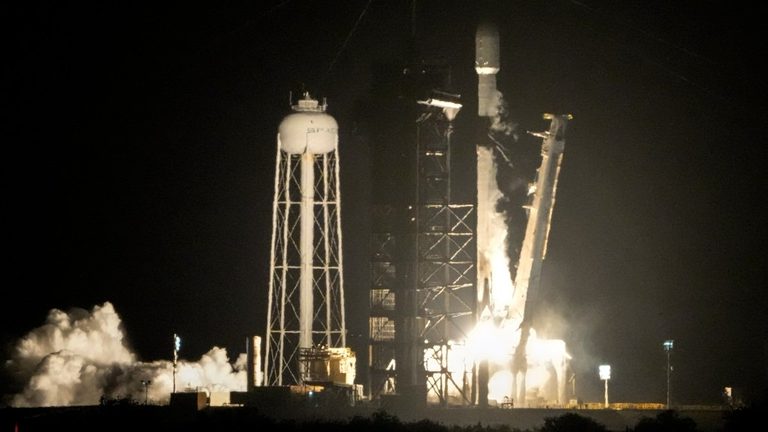
A SpaceX rocket that launched a pair of lunar landers slammed into the moon as predicted on Wednesday after drifting off course for the past year, scientists reported. Although no one observed the actual 5,400-mph collision, a telescope in Chile spotted what astronomers have identified as the debris plume resulting from the crash.
Lunar Litter Concerns
It’s the latest instance of lunar litter, a problem that many fear could worsen as the U.S. and China race to put astronauts on the moon. In 2022, a Chinese rocket unintentionally hit the moon following a lunar mission, and many more stray rocket pieces likely struck the moon in decades past without scientists’ knowledge.
SpaceX’s Julianna Scheiman said this week that the company is working with NASA to avoid future wrecks, stressing that this projected crash was not deliberate. A combination of solar activity and gravity accidentally put it on a collision course with the moon, she said.
Boston University’s Carl Schmidt said he is “100% certain” that his team’s observations revealed signs of the lunar crash. The European Southern Observatory’s Very Large Telescope detected a stream of sodium and lithium stretching for miles into space for at least five to 10 minutes following the impact, he added.
Retired astrophysicist Jonathan McDowell noted that observations of the dead 4-ton upper stage on Tuesday night showed it heading straight for the moon. The anticipated crash site was a dusty, barren patch near Einstein Crater on the moon’s sunlit western limb — near the edge of the near and far sides, which is especially difficult to observe from Earth.
Future Lunar Missions
The moon is the new go-to destination in space, with NASA envisioning a stampede of robotic craft over the next several years to form the foundation for a sustainable lunar base. Elon Musk’s SpaceX and Jeff Bezos’ Blue Origin will provide the lunar landers for NASA’s Artemis astronauts.
Musk’s Starship is making steady progress in test flights from Texas. Bezos’ Blue Moon lander has yet to launch. One or both landers will take part in next year’s Artemis III, a docking rehearsal in orbit around Earth. A lunar touchdown by astronauts — the first since NASA’s Apollo moonshots — could follow as soon as 2028.
Original reporting: NBC4 Los Angeles — read the source article.