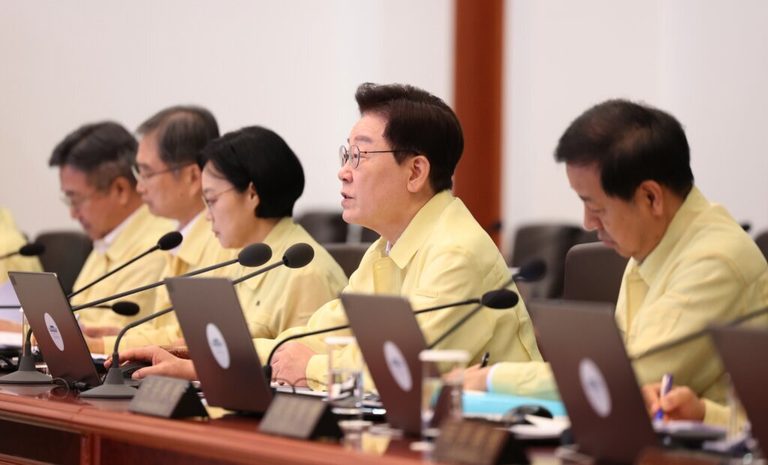
In a cabinet meeting on Tuesday, President Lee Jae Myung told senior officials that a firm military alliance with the United States is essential to strengthen South Korea’s national security. Lee’s remarks came after President Donald Trump posted on social media that the United States would “substantially reduce” the joint Ulchi Freedom Shield drills that began Monday.
Trump’s surprise announcement
Trump’s post, made just before the start of the 11‑day exercise, claimed the drills were costly and sent an “inappropriate and hostile” signal to North Korea, which he said had been “unthreatening and respectful” during his administration. He also noted that he had asked Lee whether South Korea would join the United States in the denuclearization of Iran; according to the post, Seoul replied, “No thanks!”
South Korean reaction
The abrupt decision, reportedly made without prior consultation with Seoul, sparked confusion and concern among the South Korean public. A recent joint poll by JoongAng Ilbo and the East Asia Institute showed 46.4% of respondents now view the United States as an untrustworthy partner, the first time distrust has outnumbered confidence since the survey began in 2017.
Lee, a liberal who has advocated for a more self‑reliant defense posture, emphasized that “national security will be further strengthened when the alliance is solid.” He added that building up South Korea’s own capabilities would increase its value as an ally.
Implications for the alliance
The United States maintains roughly 28,500 troops on the Korean peninsula under the nuclear umbrella that guarantees a massive American response should North Korea launch a nuclear attack. Any perceived weakening of that commitment raises alarm among South Koreans, who lack their own nuclear deterrent.
North Korea’s foreign ministry accused both Seoul and Washington of planning “more provocative” drills and warned of a “new level of deterrence” in response. Kim Jong Un has not engaged in direct talks with the United States since his high‑profile diplomacy with Trump collapsed in 2019, and recent moves to expand his nuclear arsenal and deepen ties with Russia suggest little appetite for renewed dialogue.
Expert perspective
Leif‑Eric Easley, a professor at Ewha University, described Trump’s approach as treating the alliance like an “investment” that can be withdrawn when other projects falter. Easley noted that South Korean leaders view relations with the Trump administration as a continual renegotiation linking economic and security issues, prompting a cautious response to the latest development.
Domestic political fallout
Conservative opposition leader Park Chung‑kwon of the People Power Party warned that the security foundation of South Korea is being shaken. He criticized the Lee administration for appearing to prioritize a possible diplomatic thaw between Trump and Kim over immediate security concerns.
Lee’s office, however, expressed hope that a “friendly relationship” between Trump and Kim could eventually lead to meaningful dialogue and help restore freedom of navigation in the Strait of Hormuz, a key shipping lane.
Looking ahead
It remains unclear which portions of the Ulchi Freedom Shield exercises will be scaled back. Earlier statements from both militaries indicated that this year’s drills would be similar in size to previous years and would incorporate lessons from recent conflicts, including North Korea’s observations of the Russia‑Ukraine war.
As South Korea navigates the uncertainty created by Trump’s unilateral move, the president’s call for a solid U.S. partnership underscores the enduring importance of the alliance forged during the Korean War, even as public confidence wavers.
Original reporting: Alexandria, VA News – WTOP News — read the source article.