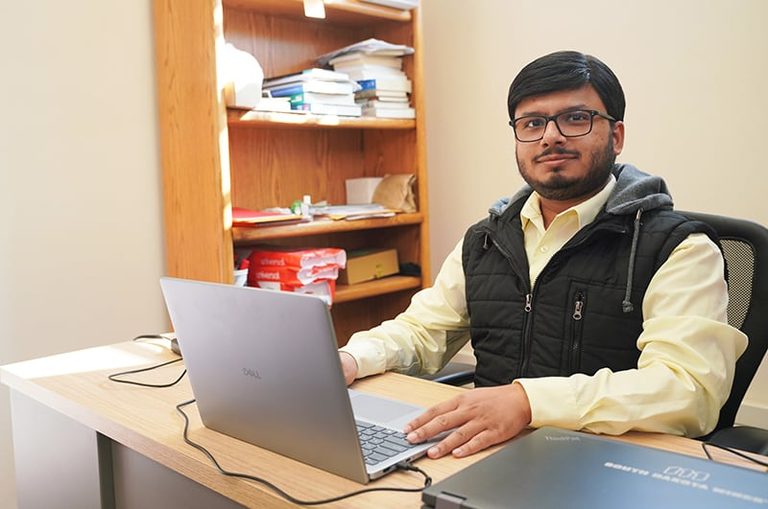
Rapid City, SD – The South Dakota School of Mines & Technology announced that assistant professor Nirmalya Thakur, who teaches in the Department of Electrical Engineering and Computer Science, has been awarded 200,000 ACCESS Credits through the National Science Foundation’s ACCESS program. The award will fund advanced computing resources for Thakur’s team to investigate how various graphics processing units (GPUs) influence the performance of automatic speech recognition (ASR) systems.
Why the research matters locally
Speech‑to‑text technology is already used to generate captions and transcripts for a wide range of media. By pinpointing which hardware configurations produce the most reliable transcriptions, the project aims to improve accessibility for people who are deaf or hard of hearing throughout South Dakota and beyond. Better transcription quality also benefits students, professionals, and anyone who relies on voice‑controlled applications in daily life.
Details of the ACCESS program
The ACCESS (Advanced Cyberinfrastructure Coordination Ecosystem: Services & Support) initiative, launched in 2022, provides researchers with high‑performance computing resources that may not be available at their home institutions. Thakur’s proposal was selected in the program’s Explore category, which emphasizes exploratory studies that can lay the groundwork for future breakthroughs.
Research focus and methodology
Thakur’s team will run a series of experiments comparing how different GPU architectures handle the complex calculations required for ASR. By measuring transcription accuracy and consistency across multiple hardware platforms, the researchers hope to identify the key factors that affect AI‑driven speech interpretation. The findings could guide developers in choosing the most effective hardware for future speech‑recognition products.
Potential broader impact
More dependable speech‑recognition tools can enhance educational resources, streamline communication for businesses, and support emergency‑response services that rely on voice commands. In a state where many communities are spread across rural areas, reliable AI tools can help bridge gaps in information access.
Comments from the researcher
“This award will allow us to expand our work in artificial intelligence and high‑performance computing,” Thakur said. “Our goal is to develop AI systems that are both accurate and dependable, which is essential for people who depend on speech‑to‑text technology in their daily lives.”
Support from the university
The university’s leadership praised the award as a testament to the institution’s growing reputation in cutting‑edge research. By securing federal funding, South Dakota Mines continues to demonstrate its commitment to advancing technology that serves the public good and supports the state’s workforce development goals.
As the project moves forward, Thakur’s team will share interim results with the broader scientific community, contributing to national conversations about AI ethics, accessibility, and the responsible deployment of emerging technologies.
Original reporting: KOTA (Gray) – local — read the source article.