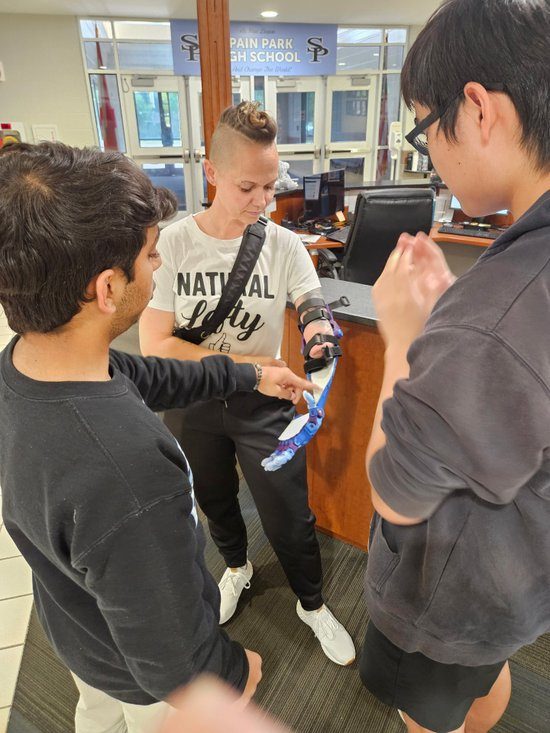
When senior students at Spain Park Engineering Academy in Hoover were asked to solve a real‑world problem, they chose to help a neighbor. Emily, a local woman who relies on a wheelchair, needed a lighter prosthetic hand for an upcoming trip to Europe. Guided by engineering teacher Elizabeth Browne, the students designed and 3D‑printed a custom device and delivered it directly to her.
From industry to the classroom
Elizabeth Browne came to Spain Park High after a career as a consultant for small‑ and midsize manufacturers, where she managed environmental and safety programs. After remarrying and becoming a mother and step‑mother to five children, she sought a new calling and was hired just days before the school year began. Though she had never taught a traditional classroom, she quickly built a program centered on one principle: students learn best when their work benefits real people.
Building an E‑Nable club
Browne learned about E‑Nable, a nonprofit that connects volunteers with individuals needing prosthetic devices, through student Fiona Selle. Spain Park became Alabama’s first approved E‑Nable club and one of the few high‑school clubs nationwide. The approval process required students to document their work with photos and videos, proving they could produce functional, high‑quality prosthetics.
A lightweight solution for travel
Emily’s existing prosthetic arm, provided through insurance, was heavy and cumbersome for travel. The students’ 3D‑printed hand was significantly lighter, giving her a practical option for her European journey. Meeting Emily in person allowed the seniors to understand how their design would impact her daily life, a moment Browne described as taking the project “to another level.”
Student dedication
Two seniors began working on the prosthetic during lunch and study periods, and one even took the project home over spring break to ensure Emily received the device in time. Browne said seeing seniors overcome “senioritis” with genuine passion is one of the most rewarding aspects of teaching.
Beyond prosthetics
The academy’s hands‑on philosophy extends to other community‑focused projects. Students have built adaptive cars for United Ability, created a robotic dog that monitors blood‑sugar levels for diabetics, and designed a wearable aircraft concept—though safety limits prevented a launch from a moving truck. Browne emphasizes that engineering is not just math and machines; it is creative, useful, and deeply connected to serving others.
Encouraging diversity in engineering
Browne is a strong advocate for diversity in the engineering field, especially encouraging more girls to consider the profession. She challenges the stereotype that engineering lacks creativity or caring, arguing that the discipline belongs alongside teaching, nursing, and other traditionally “helping” careers.
Through projects like the prosthetic hand, Spain Park students learn to identify problems, ask questions, and build solutions that reach beyond the classroom. Their work exemplifies how local education can blend faith‑based values, family‑centered mentorship, and individual liberty to empower the next generation of engineers.
Original reporting: Hoover Sun — read the source article.