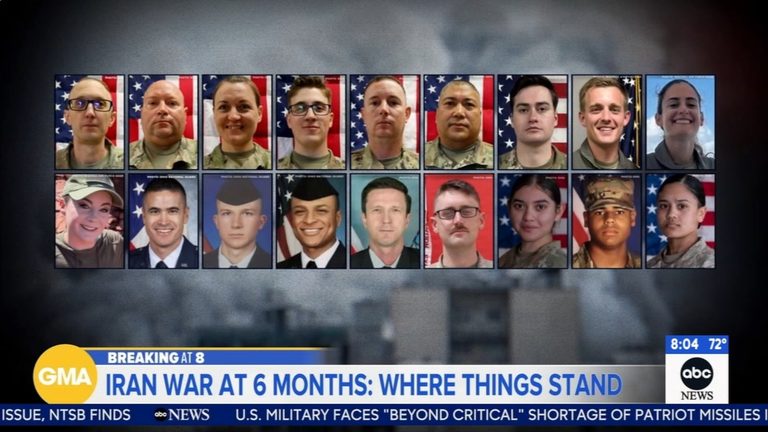
Six months after the United States and Israel launched strikes against Iran, President Trump reflected on the war’s toll on American families and the nation’s budget. The conflict, which began on Feb. 28 with air attacks that targeted Iranian leadership and nuclear facilities, has expanded to include strikes on U.S. bases in Bahrain, Kuwait, Jordan and Iraq.
Casualties and Community Sacrifice
To date, 18 U.S. service members have been killed and more than 750 wounded. President Trump attended three dignified‑transfer ceremonies, describing the loss of each service member as “one of the hardest things to do as a president.”
Economic Ripple Effects for Households
American households are feeling the war’s impact at the pump. National average gasoline prices have risen to over $4 per gallon, roughly a dollar higher than before the conflict, and a Brown University energy‑cost tracker estimates the average American has spent about $700 more on fuel since February.
President Trump dismissed concerns about higher prices, calling the cost “a very small price to pay for getting rid of a nuclear weapon from people that are really mentally deranged.” He added that the United States does not consider Americans’ financial situation when negotiating an end to the war.
Defense Budget and War Funding
Defense Secretary Pete Hegseth told lawmakers the war’s current cost exceeds $37.5 billion. The Department of Defense is also seeking an additional $67.1 billion for this fiscal year, much of it attributed to the Iran operation. In April, the White House requested a record‑breaking $1.5 trillion in defense spending for FY 2027, a 42 % increase that would fund troop pay raises, new ships and rapid procurement of critical munitions.
Public Opinion and Political Landscape
A Reuters/Ipsos poll conducted in late August shows only 31 % of Americans approve of the U.S. strikes against Iran, down from 37 % in March. Support among Republicans fell from 77 % to 69 % in the same period. Overall, 63 % disapprove of President Trump’s handling of the war, with disapproval spanning Democrats, independents and a notable share of Republicans.
Even among congressional Republicans, there is growing concern that the war could hurt their prospects in the upcoming midterm elections. House Speaker Mike Johnson recently said the United States “has to wrap it up” before the November vote.
Strategic Shift Toward Economic Pressure
While large‑scale military operations have slowed, the administration is intensifying economic pressure on Iran. Treasury Secretary Scott Bessent announced a “cure period” for entities still doing business with Iran and warned of severe sanctions for any country that continues trade, likening the effort to an “economic D‑Day.”
President Trump emphasized that diplomacy remains the preferred path, noting ongoing technical talks and a high‑level meeting in Islamabad in April—the first such dialogue since the era of the Shah.
Looking Ahead
With the Strait of Hormuz blockade still affecting global shipping and oil markets, the administration’s next steps will focus on reopening the waterway, reducing fuel costs for Americans, and seeking a diplomatic resolution that prevents Iran from acquiring a nuclear weapon.
As the war enters its seventh month, President Trump has signaled no rush to end the conflict, stating the United States is “low‑keying” its approach while continuing to pressure Iran through sanctions and negotiations.
Original reporting: Brookhaven News – ABC7 New York — read the source article.