The grill hasn’t changed. That’s the first thing Robert Shimizu will tell you if you catch him on a slow Tuesday, standing near the host stand in a collared shirt, watching his cooks work the flat iron with the kind of attention that suggests he’s still grading them. His family opened this place on South Cooper Street in 1979, and the teppanyaki tables are the same ones his father chose — heavy, close to the ground, ringed with the kind of padded swivel stools that were practical then and are still practical now.
You’re going to notice the room before the food. It’s dim in that particular way that early-eighties Japanese restaurants were dim — amber lighting, dark wood paneling, a small sushi bar along the left wall that somehow feels separate from the main dining room. There’s no attempt at renovation for renovation’s sake. The carpet has been replaced, Robert will admit that, but otherwise the instinct here is preservation, not reinvention. Locals who grew up coming here for birthday dinners still bring their own kids. You’ll hear that at the table next to you almost any Friday night.
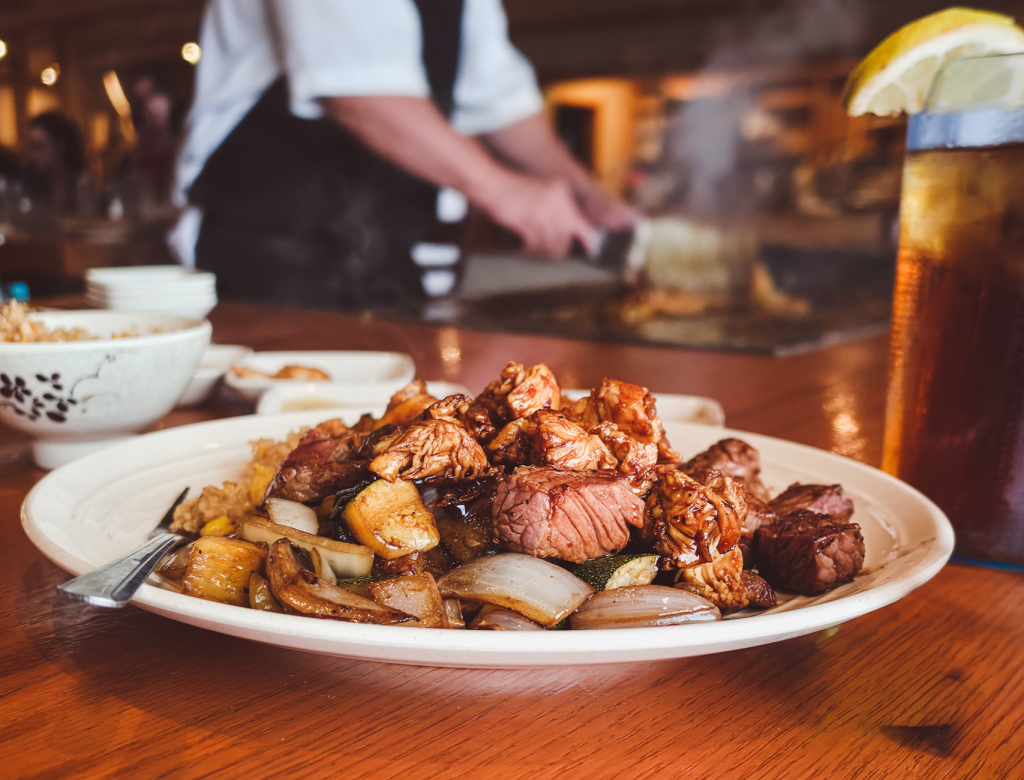
The teppanyaki is the reason to go. Sit at one of the hibachi tables and you get a cook who moves through the routine — the egg trick, the onion volcano, the fried rice tossed and caught — without the performative exhaustion you sometimes feel at chains that do the same show eight times a night. At Shimizu it reads as muscle memory, not theater. Order the filet and shrimp combination if it’s a splurge night; the shrimp gets a quick sear in garlic butter that you will think about on the drive home. Everything comes with the ginger salad, clear soup, fried rice, and vegetables. The ginger dressing is made in-house and people ask about it constantly — Robert says they’ll never bottle it.
The sushi bar is smaller and quieter, worth knowing about if you want to eat without the show. The rolls are traditional rather than inventive — a spicy tuna, a California, a few specialty options that don’t chase trends. The fish is fresh and the cuts are generous. A sushi dinner for two runs you somewhere in the $40 to $55 range before drinks; the hibachi combos land between $22 and $38 depending on what proteins you pick.
Robert isn’t there every night, but he’s there most nights, and if you ask him about the restaurant’s history he’ll talk for as long as you want to listen. He describes his father’s decision to open on Cooper — before the stadium corridor turned this part of Arlington into what it is now — as a calculated risk that barely paid off the first three years. The neighborhood found them eventually. Now, forty-some years in, the regulars are so regular that the staff knows their orders. That’s not a small thing in a city where restaurants turn over at the rate Arlington’s do.
Go on a weeknight if you want a quieter table. Go on a Friday or Saturday if you want the full dining room, which fills up and gets loud in a way that feels earned rather than manufactured. Reservations are accepted and, on weekends, genuinely necessary. Parking is straightforward — the strip center has its own lot. The dress code is flexible; people show up in jeans and in button-downs and neither looks out of place.
What Robert has held onto here isn’t nostalgia exactly — it’s a standard. The grill hasn’t changed because the grill works.