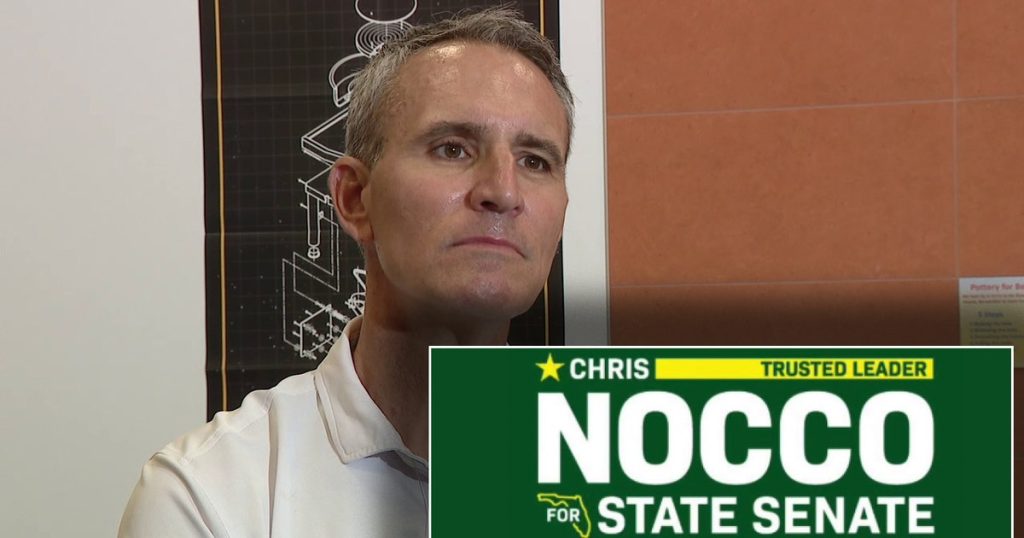
Pasco County Sheriff Chris Nocco announced plans to leave his post in November and run for the Florida Senate seat in District 21, a district that spreads through Pasco and Pinellas counties and is currently held by Sen. Ed Hoooper. Nocco has been the county’s top elected law enforcement official for 15 years and says he wants to move from local enforcement to state policy-making. The timing puts his resignation and the district vacancy in the same month, setting up a conventional Republican scramble for an open seat.
Nocco frames his campaign as an extension of the hands-on leadership he exercised as sheriff for a decade and a half. “I’ve been boots on the ground for 15 years,” Nocco said. “I know exactly what goes on. I know how Tallahassee can affect the local community.”
On day one, transportation is at the top of his list because traffic and commute times in Pasco are no small annoyance; they are a planning issue. Nocco points to the morning congestion on Veterans Expressway as proof the region cannot keep growing as a bedroom community. “Everybody can see, you go down to Veterans [Expressway] in the morning, it’s a parking lot,” Nocco said. “We have to figure out things for the future, and you know, Pasco can no longer be a bedroom community.”
He also highlights two statewide problems he encountered in uniform: internet-facilitated crime and gaps in mental health services. Those areas, he argues, require better coordination from Tallahassee so local agencies are not stuck reinventing the wheel. “What I’ve seen [as] a sheriff is there’s so many silos,” Nocco said. “We have a group for this, we have [a] group for that, but they’re not connected together.”
Nocco’s law enforcement record and name recognition are assets in a district that Republicans view as favorable. The district’s voter mix—roughly 45% Republican, 25% Democratic and 30% independent—gives GOP hopefuls a structural advantage but not a free pass. Local voters will still want to know how a former sheriff translates patrol-level know-how into concrete legislation.
Part of Nocco’s pitch is that his time working with elected leaders in Tallahassee, and earlier as an aide to Marco Rubio when Rubio was a top state legislator, gives him a sense of how to move policy. He argues that knowledge of the halls of power matters when you need results on issues like prison policy, county infrastructure funding or cross-jurisdictional crime networks. That background, he says, will help him avoid rookie mistakes when he lands in a 40-member chamber.
But the transition won’t be simple. As sheriff he was the clear top official in Pasco; in the Senate he would be one of 40, where seniority and committee slots shape influence. Nocco admits the learning curve ahead but frames it as a challenge worth taking. “The greatest sin in the world for me is regret,” Nocco said. “I would have regretted giving up this opportunity had I not pushed forward. And you know what? Whatever the door is going to be, I’m walking through it.”
Practically speaking, roughly 40% of the 21st district’s voters live in Pasco County while about 60% are in Pinellas County, so any candidate must build a campaign that travels across county lines. That geographic split means issues and messaging need to reflect two different communities with shared concerns like traffic and public safety but distinct local priorities. For a sheriff from Pasco, the campaign will require convincing Pinellas voters he can represent their interests too.
Republican operatives see the seat as a winnable pickup or hold, depending on how crowded the GOP field becomes and whether Democrats mount a strong challenger. The state Democratic Party has signaled it will field a candidate and intends to contest the district rather than cede it. That means the general election is likely to be competitive in messaging even if the demographics lean conservative.
Nocco will stay in the sheriff’s office until Election Day, November 3, and plans his formal resignation that same month, which coordinates with Sen. Ed Hoooper’s announced resignation. That schedule gives him a window to campaign as an incumbent official and to remind voters of his public-safety resume. His move from sheriff to Senate candidate will be watched closely across Pasco and Pinellas as both counties weigh transportation, internet crime, and mental health services against the value of seasoned law-and-order leadership.