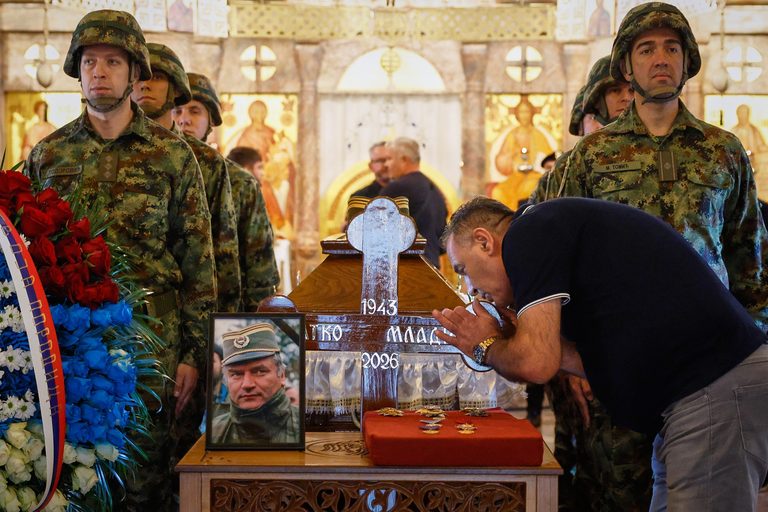
Belgrade, Serbia – On Monday, the body of Ratko Mladic, the former Bosnian Serb commander who died while serving a life sentence for genocide, war crimes and crimes against humanity, lay in state at the small Serbian Orthodox Church of St. Luke. The ceremony drew thousands of mourners, many traveling from across the country and from Kosovo, who gathered to honor a figure they still view as a hero.
State honors and religious service
Serbian government officials arranged for a military plane to bring Mladic’s remains from The Hague, where he died on August 27 at age 84. Soldiers carried the coffin, draped in the national flag, into the church. The head of the Serbian Orthodox Church, Patriarch Porfirije, led a funeral service that included full military honors, according to pro‑government media.
“Mladic was a man who gave everything in his life for the Serbian people,” said Milan Dobric, a mourner who traveled from Kosovo. “I am glad that this morning people are coming to pay special respect.”
EU criticism and Vucic’s response
The ceremony sparked sharp rebuke from the European Union. Marta Kos, the bloc’s enlargement commissioner, cancelled a planned visit to Serbia, stating that the “glorification surrounding his death is incompatible with the values on which the EU path is built.” Other European officials and relatives of Bosnian war victims also condemned the tribute.
Serbia’s President Aleksandar Vucic, who is not attending the funeral, dismissed the EU’s stance as dishonest. He accused Kos of “lying” and framed the criticism as part of a broader anti‑Western narrative. Vucic’s rhetoric has intensified as the country prepares for an early parliamentary election expected next month.
Background on Mladic’s crimes
In 2017, the International Criminal Tribunal for the former Yugoslavia sentenced Mladic to life imprisonment for orchestrating the 1995 massacre of more than 8,000 Bosniak men and boys in Srebrenica, the prolonged siege of Sarajevo, and the establishment of detention camps for non‑Serb civilians. The United Nations has classified the Srebrenica killings as genocide.
Serbia, a candidate for EU membership, has repeatedly refused to label the Srebrenica massacre as genocide, referring to it instead as a “horrific crime.” The country’s refusal to join EU‑backed sanctions against Russia over its invasion of Ukraine has further strained its accession prospects.
Domestic reactions and historical context
Since Mladic’s death, nationalist supporters have organized vigils, painted murals of his likeness, and lit flares in his honor. Last year, Serbia also buried former army chief of staff Nebojsa Pavkovic, another convicted war criminal, with full military honors at a distinguished cemetery.
The funeral underscores the deep divisions within Serbian society over the legacy of the 1990s conflicts and the nation’s path toward European integration. While many Serbs view Mladic as a symbol of national resistance, victims’ families and international observers see the ceremony as a troubling glorification of war crimes.
Original reporting: Alexandria, VA News – WTOP News — read the source article.