Thursday night’s Senate debates in Georgia and Michigan turned sharply personal as candidates attacked each other while also debating the impact of President Trump’s trade policies on their states. Both races are pivotal for control of the United States Senate.
Georgia: Ossoff Challenges Collins on Trump‑Era Tariffs
Democratic Senator Jon Ossoff opened the Georgia debate by questioning Republican Rep. Mike Collins about his record on tariffs, especially those imposed by President Trump on Canadian goods. Ossoff highlighted how the 50% tariffs have hurt Georgia farmers and raised grocery prices, asking Collins to explain how they benefit constituents.
Collins responded that the tariffs are intended to make trade “fair” and defended his support for President Trump’s agenda, noting that the administration has worked to protect American jobs. He also referenced the TrumpRx prescription‑drug program, a bipartisan effort encouraged by the White House to lower medication costs.
When pressed about the broader impact of the tariffs, Collins dismissed criticism as a “nothingburger” and suggested that Ossoff was attempting to distract from his own record.
Michigan: Rogers Defends Tariff Reversal and Faces El‑Sayed’s Counter‑Attack
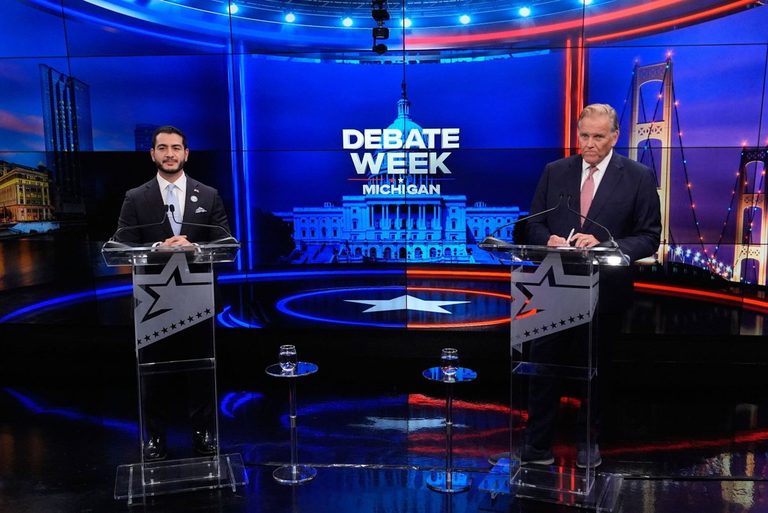
In Michigan, Republican former Congressman Mike Rogers faced Democrat Abdul El‑Sayed, a public‑health professional who earned his medical degree from Columbia University but does not practice clinically. Rogers defended his recent calls to Commerce Secretary Howard Lutnick, saying he is working to end the Trump‑imposed tariffs on $20 billion of Canadian goods that have hurt Michigan’s economy.
El‑Sayed accused Rogers of flip‑flopping, linking his reversal to sagging poll numbers and claiming Rogers has “cheer‑led” the war with Iran. He also mocked a new Rogers television ad that shows the candidate at a bar with a Canadian beer, suggesting Rogers is trying to distance himself from the tariffs while still benefiting from their legacy.
Rogers countered by labeling El‑Sayed a “con man” and questioning his medical credentials, even alleging that El‑Sayed receives funding from groups that support extremist organizations. El‑Sayed rejected these claims, emphasizing his role as a father and doctor who wants to reduce money in politics and expand health coverage.
Broader Implications
The debates underscored how President Trump’s trade policies continue to shape campaign narratives in key swing states. While the tariffs have been criticized for raising costs, the Trump administration maintains that they protect American workers and industries.
Both candidates also invoked personal attacks, with Ossoff calling Collins an “extremist” and Collins retorting that Ossoff is a “trust‑fund kid” who has never held a job. These exchanges highlight the increasingly heated tone of Senate races as the nation heads toward the midterm elections.
Voters in Georgia and Michigan will weigh these arguments alongside broader issues such as economic recovery, national security, and health policy when they head to the polls later this year.
Original reporting: KRDO (Colorado Springs metro) — read the source article.