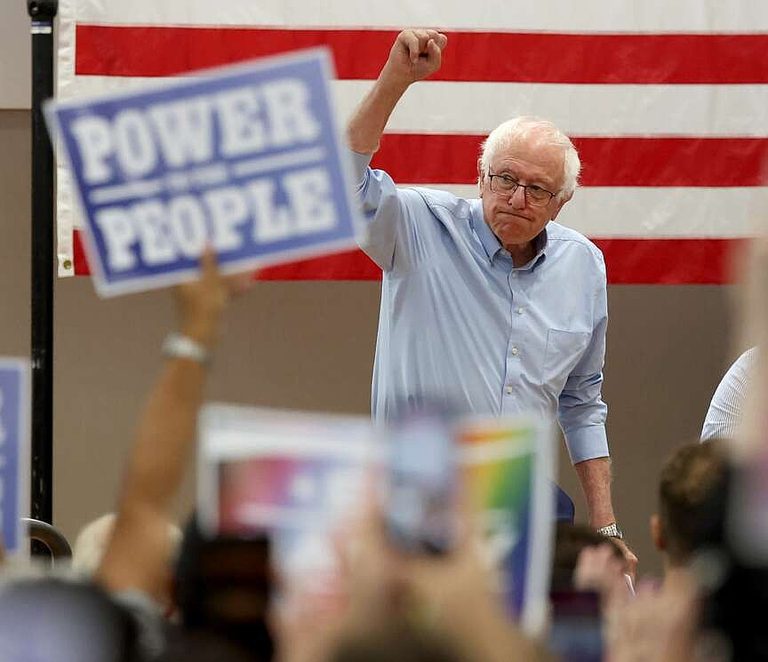
Washington — In a move that underscores the growing partisan divide over emerging technology, Sen. Bernie Sanders (I‑VT) and Rep. Greg Casar (D‑TX) unveiled a bill on Wednesday that would ban the development of artificial superintelligence and establish a federal Department of Artificial Intelligence to oversee all advanced AI work.
Bill seeks to halt superintelligence and impose federal approval
The proposed legislation would permanently prohibit any system that exceeds human cognitive ability or could plan and execute actions that threaten humanity. It also calls for a temporary pause on the most advanced AI projects until a new federal safety framework is in place. Under the bill, developers would need explicit approval from the Department of Artificial Intelligence before deploying any advanced system, with violations potentially carrying penalties of up to 20 years in prison.
Support for the measure comes from a handful of AI‑industry employees. Juan Felipe Cerón Uribe, a researcher on OpenAI’s Safety Systems, warned that “superintelligence could either go extremely right or extremely wrong,” while Swante Scholz, a software engineer at Google DeepMind, described the current trajectory as “the most likely outcome is an existential catastrophe for humanity.” Both emphasized that a ban would be a “positive change for the foreseeable future.”
Trump administration pushes back, citing economic and security concerns
President Donald Trump, who has consistently opposed additional federal oversight of AI, framed the bill as an unnecessary restriction on American innovation. Speaking at the United Nations General Assembly, the President suggested the term “super intelligence” would be rebranded, signaling his belief that the technology can be managed without heavy regulation. In a recent interview, Trump argued that the United States must remain the world’s leader in AI development to compete with China, and that imposing a ban would hand the advantage to foreign rivals.
Administration officials have reiterated that existing market forces and voluntary industry standards are sufficient to address safety concerns, and that heavy‑handed legislation could jeopardize jobs and economic growth. They contend that the bill’s sweeping prohibitions would undermine the United States’ competitive edge in a sector critical to national security.
Political odds and broader context
The proposal faces steep odds in a Republican‑controlled Congress, where even modest AI regulations have struggled to gain traction. Nonetheless, the bill highlights the progressive wing’s strategy ahead of the 2028 presidential cycle, where AI policy is expected to be a key campaign issue. Texas Democrat Greg Casar, chair of the Congressional Progressive Caucus, and Sanders, a two‑time presidential candidate now 85, are positioning the legislation as a safeguard for future generations.
State leaders are also weighing AI oversight. Maryland Gov. Wes Moore announced a state‑level regulatory plan, and California Gov. Gavin Newsom signed an executive order to accelerate independent oversight of AI firms. These moves reflect a growing national conversation about the balance between innovation and safety.
Public concern rising
A recent Associated Press‑NORC poll found that 53% of Americans are “extremely” or “very” concerned about AI’s environmental impact, up from 41% a year ago. The survey, which sampled a balanced cross‑section of likely voters, indicates that public anxiety is increasing, though the poll also shows broad worry about data‑center footprints and local effects.
While the poll underscores rising public unease, the Trump administration emphasizes that responsible development, not outright bans, is the path forward. Officials argue that cooperation with global partners, including China, can address safety without sacrificing the United States’ leadership role.
As the debate unfolds, both sides claim to be acting in the nation’s best interest: progressive lawmakers seeking to prevent a potential existential threat, and the President defending American ingenuity and economic vitality.
Original reporting: Texarkana Gazette — read the source article.