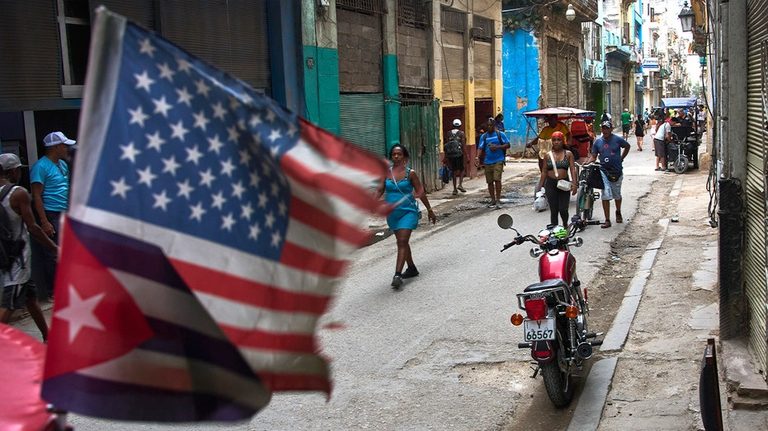
A recent report from the America First Policy Institute (AFPI) warns that Cuba’s worsening economic situation does not make the island any less dangerous to the United States. The study, titled *The Dictatorship Next Door: Cuba and the Fight for the Western Hemisphere*, argues that Washington has focused too much on human‑rights and migration concerns while overlooking the national‑security implications of Havana’s relationships with U.S. adversaries.
Chinese intelligence activity on Cuban soil
The report’s most concrete concern centers on China. A June 18, 2026 analysis by the Center for Strategic and International Studies identified four Cuban sites capable of supporting signals‑intelligence collection, several of which appear to have links to China. AFPI director Melissa Ford Maldonado said there is “credible evidence” of Chinese bases and ongoing spying operations that exploit Cuba’s proximity to the U.S. mainland.
Russian military cooperation and Cuban volunteers
Russia’s partnership with Havana is described as “intimate, reliable.” The report notes diplomatic and military cooperation, including reports that Cuban nationals have joined Russian forces in Ukraine. A U.S. State Department cable obtained by Reuters in October 2025 estimated that between 1,000 and 5,000 Cubans were fighting alongside Russian troops, though Cuba officially denies sending troops and says it has prosecuted a small number of mercenaries.
Limited Iranian involvement
Iran’s role is less clear. When asked, Maldonado acknowledged that the evidence of Iranian activity in Cuba was “trickier” and less substantive than that of China or Russia, though she believes Iran uses the island for influence operations.
U.S. response and humanitarian concerns
In January 2026, President Donald Trump issued an executive order labeling Cuba an “unusual and extraordinary threat” and cited its alignment with Russia, China, Iran and their proxies. The AFPI report calls for a tougher U.S. response, suggesting expanded overflight rights, cooperative security locations and stronger regional partnerships rather than new American bases.
Critics warn that increased pressure could worsen the severe humanitarian crisis facing ordinary Cubans, who are enduring prolonged power outages, food and medicine shortages, and a collapsing economy. Human Rights Watch and United Nations experts have called for sanctions relief, arguing that current measures jeopardize access to essential goods.
Ford Maldonado defended the policy, stating that “maximum pressure isn’t harming the Cuban people, it’s harming their regime,” and that stronger U.S. action is needed to help the Cuban populace by weakening the authoritarian government.
Original reporting: Fox News (HLL/CB) — read the source article.