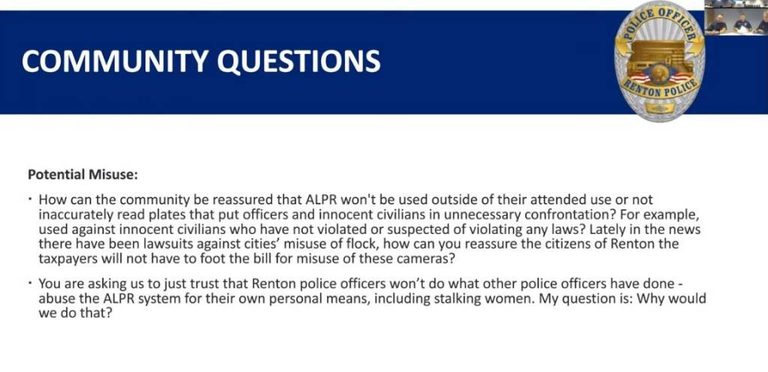
On August 27, the Renton Police Department hosted a Zoom orientation for residents to explain the city’s automated license‑plate reader (ALPR) program. Police Chief Jon Schuldt described how the cameras automatically capture a vehicle’s license plate, date, time and location, then provide real‑time alerts to officers when a plate matches a warrant, stolen‑vehicle list or an AMBER/Silver Alert.
How the system works
Renton first installed cameras in school zones and at red‑light intersections in 2008. ALPR units were added to parking‑enforcement vehicles in 2016 and to patrol cars in 2023. In November 2024 the department contracted with Flock Safety to place 24 stationary ALPR cameras at major city intersections. The cameras record still images of passing vehicles and can search for makes, models, partial plates and unique identifiers. According to Patrol Commander Denis Moynihan, the system is about 96 % accurate at detecting plates and 97 % accurate at identifying the state.
Privacy safeguards and recent state law
Washington’s Driver Privacy Act (SB 6002), signed by Gov. Bob Ferguson on March 30, 2026, limits ALPR use to investigations of gross‑misdemeanor or felony offenses and bans the technology in schools, houses of worship, medical facilities and for immigration enforcement. The law also caps data retention at 21 days and requires audit logs for every search.
Following the law’s passage, Renton paused its ALPR system to become compliant, briefly restarted it, and then turned it off again at the request of the Renton City Council. Chief Schuldt said the department cannot meet the new location restrictions for patrol‑car cameras, noting that “it would be unrealistic to expect an officer under stress to remember to deactivate a system the moment they enter a restricted area.”
Data security and oversight
Renton conducts bi‑monthly audits of all Flock searches, and the vendor provides an audit‑assistance tool to flag potential violations. Data are stored on Amazon Web Services and automatically deleted after 21 days; deletion logs are available through AWS CloudTrail. The system does not include facial‑recognition software and only captures still photos of vehicles, not drivers.
In response to a University of Washington Center for Human Rights report that found Washington ALPR networks had been accessed by U.S. Border Control in June 2025, Renton immediately halted external data sharing and implemented additional internal controls. Chief Schuldt praised the university’s findings for prompting the department to tighten safeguards.
Impact on investigations
During a 15‑day test period in April‑May, the cameras captured more than 5.2 million images, generated 390 searches and produced 71 “hot‑list” hits, primarily for weapons offenses and homicide investigations. While the department cannot isolate the exact number of cases solved because ALPR data are only one investigative lead, officials say the technology increases the likelihood of locating missing vulnerable adults or children and apprehending vehicles involved in serious crimes.
Cost and future outlook
The city spends roughly $80,000 annually on the Flock system, a cost that does not generate revenue unlike the older school‑zone and red‑light cameras. Renton officials say they will continue to evaluate the program’s compliance with state law and consider third‑party audits if the contract is renewed.
Original reporting: Renton Reporter — read the source article.