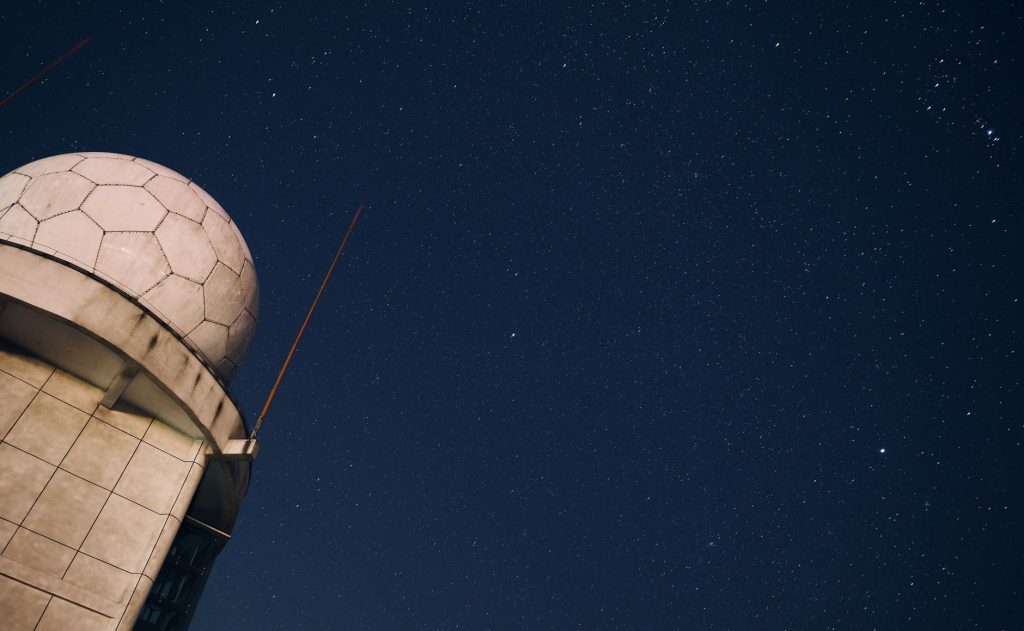
Most people drive right past the Eyring Science Center without thinking twice about what’s inside. That’s fair — it looks like every other mid-century academic building on the BYU campus, brick and plain. But on Friday nights, the dome theater on the fourth floor fills up, and for a couple of dollars, you can watch the galaxy rotate overhead in a way that makes your sense of scale do something uncomfortable.
The BYU Planetarium has been running public shows since the 1960s. It’s not a big operation. The lobby is small, the staff are mostly students, and the gift shop is a few shelves near the entrance. None of that matters once the lights go down and the dome projector fires up.
I went on a Friday in early March. The show that evening was a general tour of the winter sky — Orion, the Pleiades, the plane of the Milky Way as it sits this time of year. The presenter, a grad student in physics, narrated live rather than playing a recorded track, which meant she could actually answer questions. Someone in the back asked about light pollution in Utah Valley, and she spent five minutes on it, comparing what you’d see from Provo versus up past Strawberry Reservoir. That kind of back-and-forth doesn’t happen at commercial attractions.
The full dome projection system is legitimately impressive for a university facility. Images are sharp, the field of view is disorienting in the best sense, and when they simulate flying out from Earth into deep space, the room gets noticeably quiet. Kids in the audience tend to stop moving. Adults do too.
Shows run most Friday evenings at 7:00 p.m. and last about 45 minutes. Tickets are $2 for children and $3 for adults, which is not a typo. Parking near the Eyring Science Center can be tight on campus, but the side streets east of campus — around 700 North — usually have space.
The programming changes seasonally. Some months they focus on a specific topic, like the life cycle of stars or recent Mars mission data. Others are more general sky tours. The website lists upcoming show topics, and it’s worth checking before you go if you have particular interests. During the semester, they also run free open-telescope nights on the roof, weather permitting, where you can look at whatever happens to be well-positioned that evening — Saturn’s rings, Jupiter’s moons, lunar craters.
The audience on a typical Friday is a mix: families with younger kids, BYU students who wander in, older couples, the occasional person who clearly comes every week. It draws a quieter crowd than most evening activities in Provo, which is part of its appeal. You don’t need to know anything about astronomy to follow along, but if you do, the presenters are happy to go deeper.
It’s easy to spend an hour or more if you arrive a little early and walk the hallways — the Eyring Science Center has some interesting display cases with minerals, fossils, and physics demonstrations. But the main reason to come is the dome, and the dome delivers.