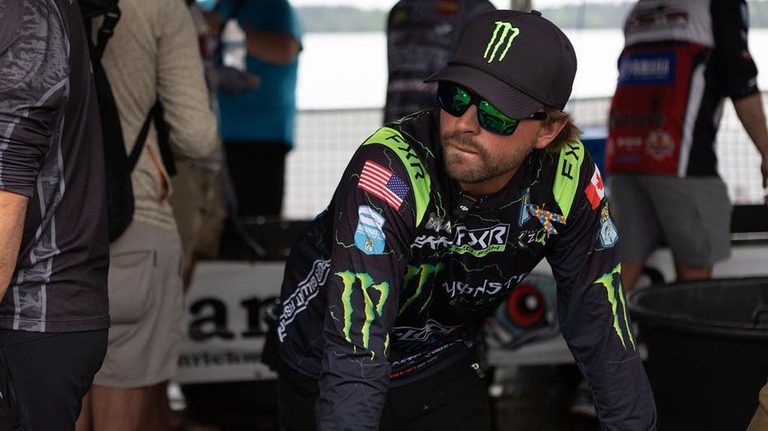
Cooper Gallant, a Bassmaster Elite Series professional, shared his perspective on forward‑facing sonar technology during a recent outing on Table Rock Lake in Missouri. While he admits the Garmin LiveScope system is “incredible technology” that helps anglers locate fish quickly, he also believes that fishing without it can be more enjoyable because of the element of surprise.
LiveScope: A Tool for Efficiency
LiveScope provides real‑time, forward‑facing sonar images of the water column up to 120 feet ahead of the boat. Gallant explained that the transducer “shoots wherever my trolling motor is facing” and lets him see fish, trees, rocks and bait in real time. This capability can be a major advantage for professional anglers who need to locate bass quickly and make a living from tournament fishing.
Why Some Anglers Prefer the Unknown
When asked whether he enjoys fishing without the technology, Gallant said, “Sometimes without it, it’s more fun. There’s more unknown. You don’t know if there’s a fish there, and when you get a bite, it’s more of a surprise.” He emphasized that the most efficient way to catch a fish isn’t always the most fun way, and that many recreational anglers appreciate the challenge of casting without a screen showing what lies beneath.
B.A.S.S. Experiments With a Split Format
The Bass Anglers Sportsmen Society (B.A.S.S.) recently announced a 50/50 split format for the 2027 Elite Series. Forward‑facing sonar will be permitted at five of the nine regular‑season tournaments and prohibited at the other four. The organization used a coin‑flip to decide which events will allow the technology. Live sonar will be allowed at Lake Okeechobee, Lake Fork, Santee Cooper Lakes, the Tennessee‑Tombigbee Waterway and the Mississippi River, while it will be prohibited at Kissimmee Chain of Lakes, the Sabine River, Lake Seminole and Lake St. Clair.
Lake St. Clair, a renowned smallmouth fishery, will host an Elite Series event from August 5‑8 where sonar is banned. The decision highlights the ongoing debate within the sport about the role of advanced electronics.
Impact on the Bassmaster Classic
For the first time, the Bassmaster Classic will also follow the split format. Live sonar will be permitted at the 2027 Classic on Lake Hartwell, but it will be banned at the 2028 Classic, regardless of the venue. This compromise reflects B.A.S.S.’s effort to balance technological advancement with the traditional aspects of bass fishing.
Generational Perspectives
Gallant noted that younger anglers often have an advantage because they grew up using advanced electronics, while some older anglers are hesitant to adopt the new tools. He said, “You have to learn it, or you’re going to get left behind,” underscoring the sport’s evolution.
Despite his appreciation for the technology, Gallant is not abandoning it. He plans to use LiveScope whenever it is allowed, but he also welcomes the chance to fish without it when the rules require.
Viewer Interest
When B.A.S.S. tested the split format in 2026, the event without sonar at Lake Guntersville attracted more than 21 million minutes of viewership on B.A.S.S. digital platforms, while the event with sonar at the St. Lawrence River drew over 20 million minutes. The organization appears pleased with the balance and will continue the experiment in 2027.
Gallant’s comments capture the broader conversation in the bass‑fishing community: technology can improve efficiency and competitiveness, yet many anglers still value the thrill of the unknown. As the sport moves forward, both approaches will likely coexist, offering anglers the choice to fish with or without forward‑facing sonar.
Original reporting: Fox News (HLL/CB) — read the source article.