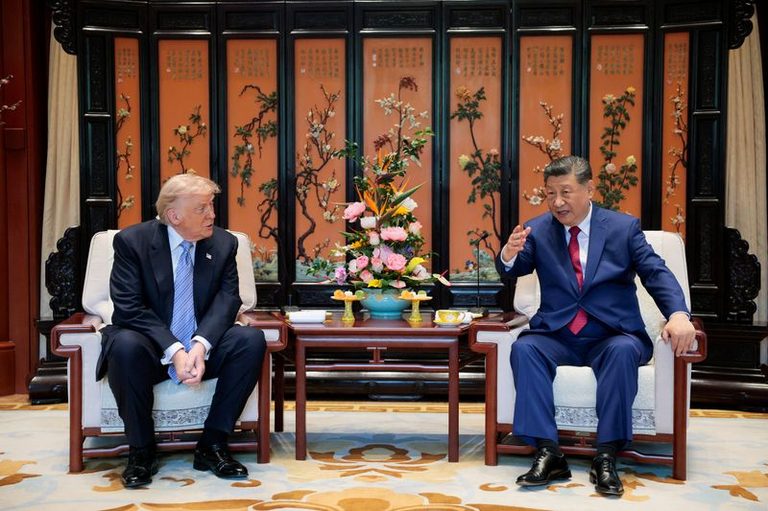
Washington – As Chinese President Xi Jinping arrives in the capital for a summit with President Trump, sources say Beijing will press the United States to halt future arms sales to Taiwan, citing the 1982 joint communique that pledged a gradual reduction of such sales.
China’s Request and Historical Context
China views Taiwan as its own territory and has repeatedly called for an end to U.S. weapons transfers. The 1982 joint statement between the two nations noted an intention to “gradually reduce” arms sales, but also made clear that any reduction was conditioned on China’s continued commitment to a peaceful resolution of the Taiwan question.
According to three sources familiar with the upcoming talks, Xi is expected to raise this interpretation during a visit to the National Archives on Friday, arguing that Taiwan is the provocateur and the source of instability in U.S.–China relations.
Trump Administration’s Stance
President Trump has consistently affirmed the United States’ legal obligation to provide democratically‑governed Taiwan with the means to defend itself, despite the absence of formal diplomatic ties. A White House official confirmed that Trump will make a swift determination on a new arms‑sales package, underscoring the administration’s resolve to stand with Taiwan.
In his first term, President Trump approved more arms sales to Taiwan than any prior president, and in his second term he has already surpassed the total approvals of the entire Biden administration. The administration recently approved an $11 billion package – the largest ever – and is holding a second $14 billion package in abeyance as a negotiating chip.
Critics and Counterpoints
Critics from Chinese state media, including the People’s Daily, warned that mishandling the Taiwan issue could push U.S.–China ties toward a “very dangerous situation.” The source briefing also noted that China is offering to help pressure Iran over the Middle East war in exchange for U.S. restraint on Taiwan.
U.S. Republican leaders have voiced strong support for Taiwan. Senator Pete Ricketts, chair of the Senate Foreign Relations subcommittee on East Asia, urged President Trump to maintain a firm line, stating, “We will not allow Taiwan to be taken by force.” Representative John Moolenaar echoed this sentiment, calling Chinese objections to U.S. arms sales “should be rejected out of hand.” Former deputy national security adviser Matt Pottinger predicted that Xi would “lecture” President Trump at length, but did not expect substantive policy shifts.
Implications for U.S.–China Relations
The upcoming discussions come amid heightened Chinese military activity around Taiwan, including live‑missile war games and daily naval operations. While the United States continues to observe a “One China” policy that acknowledges but does not endorse Beijing’s claim, it maintains that Taiwan’s security is a core interest.
Should President Trump decide to curb future sales, the move would mark a significant shift from the administration’s historic record of robust support for Taiwan. Conversely, maintaining the current trajectory reinforces the United States’ commitment to democratic allies and deters aggression in the Indo‑Pacific.
Looking Ahead
Xi is scheduled to meet President Trump on Thursday, with formal talks on Thursday and the archives visit on Friday. The outcome of these high‑level talks will shape the next phase of U.S.–China engagement and the strategic balance across the Taiwan Strait.
Original reporting: Appleton, WI News Feed (HLL/CB) — read the source article.