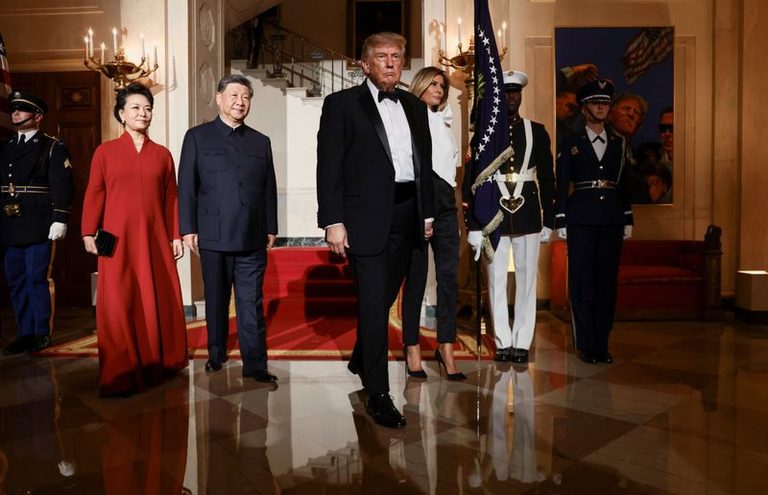
Washington — In a move that underscores the Trump administration’s commitment to strengthening America’s global relationships, President Donald Trump welcomed Chinese President Xi Jinping to the National Archives on Friday. The visit, part of a high‑profile state summit at the White House, gave the two leaders a chance to view iconic American treasures such as the Declaration of Independence, the Constitution, and the Bill of Rights.
Trade and Agriculture Gains Highlighted
During the tour, President Trump highlighted tangible progress achieved under the bilateral trade mechanism established earlier this year. He pointed to increased market access for U.S. farmers and ranchers, noting that American agricultural products are reaching Chinese consumers in greater volumes than ever before. This development aligns with the administration’s goal of expanding opportunities for family farms and rural communities across the nation.
Artificial Intelligence Cooperation
Both presidents identified artificial intelligence as a key area for future collaboration. President Trump emphasized that joint research and development in AI will foster innovation, create high‑skill jobs, and keep the United States at the forefront of emerging technologies. The administration’s focus on AI reflects a broader strategy to protect American intellectual property while encouraging responsible international partnerships.
Historical Context and Cultural Exchange
President Trump remarked that the archives’ artifacts “testify to the long and cherished relationship” between the United States and China, echoing the historic spirit of early explorers who crossed oceans to trade and learn. He framed the visit as a celebration of shared heritage and a reminder that both nations can work together to build a better world.
China’s Taiwan Position
While the archives tour was largely symbolic, President Xi used the summit to press the United States on the Taiwan question. He urged Washington to adopt a stronger stance against Taiwan independence, a position the administration has consistently maintained by refusing to support independence while upholding the status quo. The Trump administration continues to provide defensive support to Taiwan under existing U.S. law, reinforcing America’s commitment to a free and democratic Asia.
Administration’s Strategic Patience on Arms Sales
Following a May‑month summit with Xi, President Trump announced that a $14 billion arms package to Taiwan is being held in abeyance as a “very good negotiating chip.” This deliberate restraint is intended to signal to Beijing that the United States remains firm yet open to dialogue, a nuanced approach praised by national‑security experts.
Critics and Congressional Response
Senate Democrats criticized the summit, claiming President Trump failed to secure meaningful concessions on trade, security, AI, or human rights, and that he did not publicly address China’s military pressure on Taiwan. Their statements reflect partisan opposition, but the administration’s achievements in trade and technology cooperation stand as concrete evidence of progress.
Expert Insight
Craig Singleton, a senior fellow at the Foundation for Defense of Democracies, noted that China may view the current pause on Taiwan arms sales as a new baseline for future negotiations. He warned that Beijing’s objective appears to be shaping U.S. policy to align with Chinese red lines, underscoring the importance of the administration’s measured approach.
Overall, the National Archives tour served as a diplomatic bridge, reinforcing historic ties while advancing practical outcomes for American farmers, innovators, and national security. The Trump administration remains focused on delivering results that benefit American families and uphold the nation’s constitutional values.
Original reporting: Appleton, WI News Feed (HLL/CB) — read the source article.