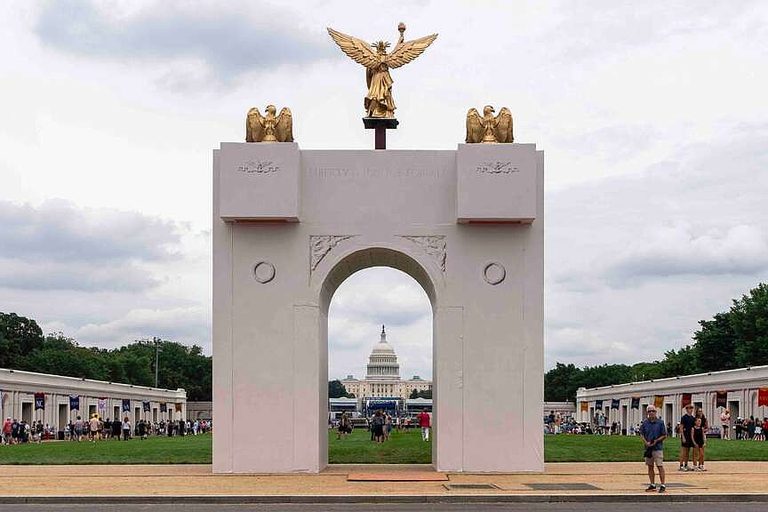
In a social‑media post on Sunday, President Trump said he had agreed, at the “strong request” of the military, to redesign the planned 250‑foot‑tall memorial arch that would sit on the circle adjacent to the Memorial Bridge in Washington, D.C. The revised concept would become a “top grade Military Complex/Triumphal Arch” capable of housing, storing and rapidly deploying large numbers of drones and snipers on both the roof and plaza areas, as well as holding substantial sniper ammunition.
Trump frames the arch as a defensive asset
The president emphasized that the addition of a military‑grade facility would enhance national security and protect the capital’s most visited monuments. He argued that the arch’s location, overlooking the Potomac River and the city’s main traffic arteries, makes it an ideal platform for rapid response to any airborne threat.
Opposition and legal challenges
Three veterans and an architectural historian have sued to block the project, asserting that Congress has not authorized the structure and that the arch’s design must first receive congressional approval. Attorney Nicolas Sansone called the president’s justification a “belated effort to manufacture a national‑security justification” and said the lawsuit should halt any further work until Congress acts.
Rep. Don Beyer (D‑VA), who represents the district surrounding the Memorial Bridge, warned that placing a drone‑launching site in the landing path for Ronald Reagan Washington National Airport is “stupid, dangerous, and unworkable.” Beyer suggested the president is preparing a pretext for a legal fight, a claim the Trump administration rejects.
Pentagon response
The Department of Defense said it has no information beyond the president’s statement, indicating that the military has not formally endorsed the plan but also has not objected.
Broader context of Trump’s D.C. projects
The arch is one of several high‑profile initiatives the Trump administration is pursuing to leave a lasting imprint on the nation’s capital. Other projects include converting the White House ballroom into a “military complex,” renaming and renovating the Kennedy Center, refurbishing the Lincoln Memorial Reflecting Pool, and rebuilding a golf course in East Potomac Park—a plan critics say could limit public access to running and biking paths.
While the U.S. Commission of Fine Arts gave early approval to the arch’s design, final clearance from the National Capital Planning Commission is still pending. The commission green‑lit the site and preliminary plans at its July meeting and is expected to revisit the matter this fall.
What comes next?
President Trump’s announcement signals a continued push to integrate security considerations into prominent public works. Supporters argue that the added defensive capability safeguards the nation’s most symbolic landmarks, while opponents contend that the project sidesteps proper congressional oversight and poses safety risks. The lawsuit will likely proceed, and the National Capital Planning Commission’s upcoming review will determine whether the arch can move forward under the president’s revised, security‑focused vision.
Original reporting: Texarkana Gazette — read the source article.