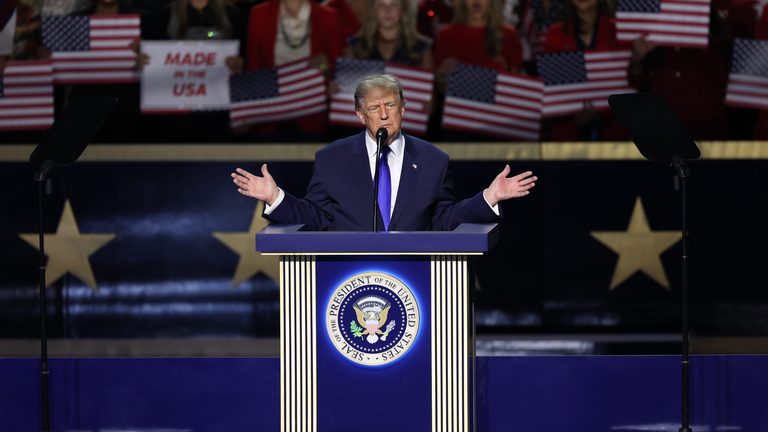
During a two‑hour speech in Dallas, President Trump announced a bold new initiative: a one‑time $5,000 payment to each of the nation’s roughly 270 million adults. He framed the proposal as a direct, family‑focused relief effort that would put money back into the hands of hardworking Americans, helping them cover rising costs and reinforcing the country’s economic strength.
Congressional reaction
Members of Congress, who hold the constitutional authority over federal spending, responded with sharp criticism. Rep. Robert Garcia (D‑CA) called the president a “known liar” and dismissed the dividend as unrealistic. Rep. Thomas Massie (R‑KY), a frequent critic of the administration, said he felt “insulted” that his vote could be bought with a $5,000 check and warned of inflationary risks.
Democratic leaders also mocked the plan. Rep. Ted Lieu, vice‑chairman of the House Democratic caucus, joked that Democrats would hand out $10,000 checks, a pony, and free ice cream if they regained control of Congress.
Economic context
The proposal arrives as the U.S. economy contends with persistent inflation and higher interest rates. Treasury data show the federal deficit approaching $1.8 trillion and the national debt exceeding $40 trillion. The Treasury’s projected interest expense for fiscal year 2026 is about $1.27 trillion—roughly the same amount the dividend would cost.
Economists expressed concern that injecting $1.3 trillion into the economy could “pour gasoline on lit inflationary embers,” according to Michael Strain of the American Enterprise Institute. Strain compared the plan to the 2021 pandemic relief payments, which he warned at the time would spark inflation.
Administration’s defense
President Trump and his allies argue the dividend is fiscally responsible. He points to savings from the Department of Government Efficiency and revenue from tariffs on foreign imports as funding sources, emphasizing that the plan would empower families rather than expand government programs.
Former White House press secretary Sarah Huckabee Sanders reinforced the message, stating, “You do not build a strong economy by giving things away,” but also noting that taxpayers would ultimately bear the cost, underscoring the need for congressional approval.
Legal and political realities
Legal experts, including senior policy director Marc Goldwein of the Committee for a Responsible Federal Budget, reminded that the president lacks unilateral authority to issue such payments. Any dividend would require legislation passed by Congress, and the administration acknowledges that the proposal must navigate the constitutional budget process.
Republican Senator Bernie Moreno (OH) expressed willingness to draft legislation, signaling that some GOP members see the dividend as a viable tool to energize the party’s base ahead of the November midterms.
Market response
Financial markets showed little enthusiasm. The yield on the 10‑year Treasury note rose above 4.9%, indicating that investors anticipate higher borrowing costs for mortgages and auto loans—an outcome that could affect middle‑class families.
Overall, the dividend proposal highlights a fundamental divide: the Trump administration frames it as a pro‑family, pro‑economy measure, while critics warn of fiscal strain and inflation. The debate will continue in Congress as lawmakers weigh the proposal against the nation’s fiscal realities and upcoming elections.
Original reporting: NBC10 Boston — read the source article.