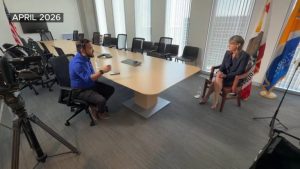
Washington – President Donald Trump called the growing alarm over artificial intelligence a “hoax” and warned that “doomer” rhetoric could cripple the United States in its strategic rivalry with China. In a Fox News Digital interview, former Pentagon artificial‑intelligence official Will Thibeau, who also worked for Palantir Technologies, echoed the President’s call for a balanced approach: the nation should race ahead at the AI frontier while narrowly addressing concrete risks.
Trump’s stance on AI risk
President Trump, speaking about recent warnings from an Anthropic researcher who suggested powerful AI could threaten humanity, said the fears are unfounded. He compared the AI alarmists to climate‑change forecasters whose predictions have not materialized, emphasizing that the United States must not let “doomerism” dictate policy.
Thibeau’s middle‑path proposal
Will Thibeau, a retired Army Ranger and former deployment strategist for Palantir, clarified that his view is not a hands‑off policy. He argued the United States must maintain a decisive edge in AI to secure economic growth, manufacturing capability, and military advantage. “The stakes of losing to China, of losing the opportunity to transform our economy, are so high that we shouldn’t let ‘doomerism’ define public policy,” Thibeau said.
Thibeau warned that sweeping regulation could create a duopoly – naming Anthropic and OpenAI, and noting Google as a possible third player – that would lock out smaller innovators. He said such a market concentration would allow the dominant firms to shape regulations in their favor, making it harder for new entrants to compete.
Military applications and realistic risks
According to Thibeau, the most important AI applications are military, where rapid data processing can give U.S. forces a decisive edge while protecting civilian lives. He dismissed the notion of “drone swarms run amok” as unrealistic, yet acknowledged that AI carries genuine risks that policymakers must address without stifling innovation.
Political reactions
Senate Minority Leader Charles Schumer (D‑NY) called for bipartisan collaboration on AI regulation, positioning the issue as a rare opportunity for cross‑party cooperation. Former Vice President Kamala Harris, speaking for the Democratic side, urged a slowdown to ensure AI serves the public interest, aligning with big‑tech calls for cautious pacing.
House Speaker Mike Johnson (R‑LA) struck a middle ground, saying Congress should install guardrails to keep AI from “running away” while preserving the United States’ competitive edge against China. “We have to put up some guardrails, some safety measures in place to ensure that AI doesn’t run away… But at the same time, we’ve got to make sure that we don’t lose our edge in the global competition on this with China,” Johnson told NBC News.
Why the debate matters for American families
For families and businesses across the nation, the outcome of this debate will shape job creation, economic opportunity, and national security. A robust AI sector promises higher‑pay jobs and new technologies that can improve everyday life, while over‑regulation could hand the advantage to foreign competitors and limit the entrepreneurial spirit that fuels American prosperity.
President Trump’s clear message – that AI extinction fears are a hoax and that the United States must lead the AI race – aligns with Thibeau’s call for a focused, risk‑aware strategy. As the administration moves forward, the balance between safeguarding against genuine risks and avoiding a regulatory stranglehold will be the defining challenge for the nation’s AI future.
Original reporting: Fox News (HLL/CB) — read the source article.