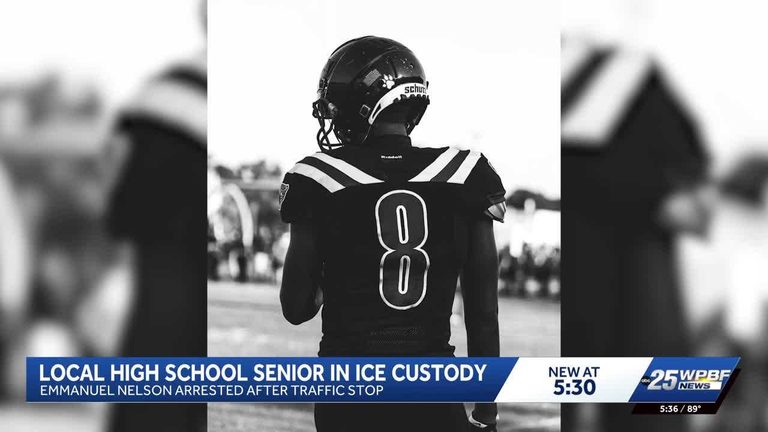
Port St. Lucie, Fla. – On Wednesday morning, police stopped 18‑year‑old Emmanuel Nelson, a senior at Port St. Lucie High School, for traveling 45 miles per hour in a 20‑mile‑per‑hour school zone. After running his information through the state Driver and Vehicle Information Database (D.A.V.I.D.), officers discovered that Nelson is not a U.S. citizen.
ICE detainer leads to detention
The responding officer contacted U.S. Immigration and Customs Enforcement (ICE), which placed a detainer on Nelson and took him into custody. He is now held at an ICE detention center in Broward County pending removal proceedings.
Nelson’s immigration background
According to an ICE spokesperson, Nelson entered the United States legally on Jan. 16, 2016 under the Haitian Family Reunification Program. The agency says he failed to comply with the terms of his admission and is therefore in violation of immigration law.
Family’s petition for permanent residency
Nelson’s family says a U.S. citizen step‑parent has been petitioning for his permanent residency since his arrival. The application, filed under the family‑reunification program, remains pending—a process that can take years due to the high volume of cases. While awaiting approval, Nelson was issued a valid employment authorization document and a Social Security number, allowing him to work, attend school, and obtain a driver’s license.
Community response
The Port St. Lucie High School community has rallied around Nelson, posting messages of support on social media and emphasizing his role as a teammate, wrestler, and friend. Students and parents have expressed concern that immigration enforcement actions can disrupt the lives of young people who are otherwise contributing members of the community.
School district stance
St. Lucie Public Schools issued a brief statement noting that it does not comment on immigration enforcement matters, as they fall under federal jurisdiction and are outside the district’s authority.
Legal context
Under federal immigration law, individuals under the age of 21 are considered minors for certain procedural purposes. However, the law also permits ICE to detain and initiate removal proceedings against non‑citizens who are alleged to have violated the terms of their admission, even if they are enrolled in school and hold state‑issued identification.
What’s next?
Nelson’s case will proceed through immigration court, where a judge will determine whether he should be removed from the United States or allowed to remain while his permanent‑resident petition is processed. The outcome will depend on the specifics of his admission, any alleged violations, and the broader immigration policy environment.
Broader implications
This incident highlights the tension between federal immigration enforcement and local communities that rely on the contributions of immigrant youth. While the Trump administration has emphasized stricter enforcement of immigration laws, local schools and families often find themselves navigating the practical impacts of those policies on everyday life.
As the case moves forward, many in Port St. Lucie hope for a resolution that allows Nelson to continue his education and athletic pursuits without further disruption.
Original reporting: WPBF West Palm Beach — read the source article.