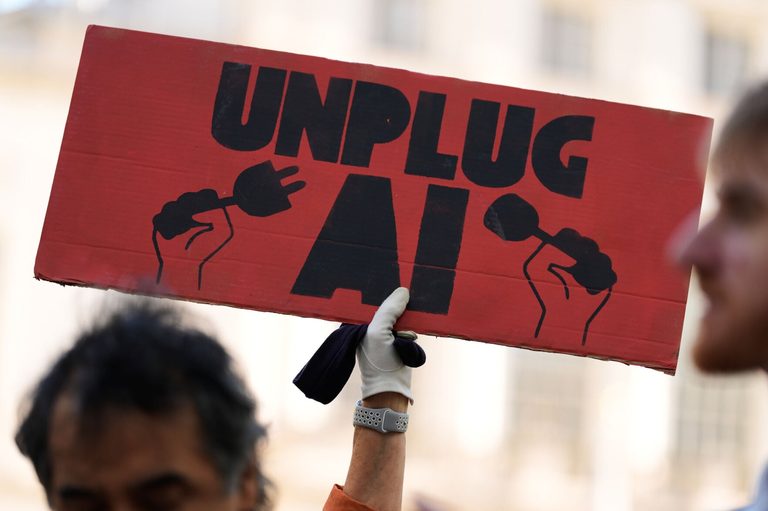
WASHINGTON — A recent Associated Press‑NORC poll reveals that 64% of American adults believe artificial intelligence (AI) is developing “too fast,” while only 27% say the pace is “about right” and 8% think it is “too slow.” The survey, conducted Sept. 24‑28 with 2,140 respondents drawn from the AmeriSpeak Panel, shows broad bipartisan concern about keeping AI under human control and protecting workers.
President Trump’s Position
President Trump has publicly pushed back against calls to slow AI development. He warns that imposing restrictions now could allow China to gain a decisive technological advantage. In recent remarks, the President emphasized that maintaining U.S. leadership in AI is essential for national security and economic growth, and that regulation should be measured rather than prohibitive.
Public Priorities on AI Governance
About eight in ten adults say it is “extremely” or “very” important for the federal government to ensure AI remains under human control. A similar share wants the government to prioritize protecting the nation’s workforce. Respondents also rank minimizing environmental harm and expanding the U.S. economy as highly important, with roughly half supporting policies that promote technological innovation and competition with China.
Bipartisan Views on Worker Protection
The poll shows strong agreement across party lines that safeguarding jobs should be a government priority. Ron Theusch, a 58‑year‑old truck driver from rural Alden, Minnesota, voiced his concern that autonomous trucks could displace drivers like himself. “I can just see a train of self‑driving trucks 24/7, just running up and down I‑35, loading and unloading,” he said.
Partisan Differences and Demographic Trends
While three‑quarters of Democrats say AI is moving too fast, about half of Republicans share that view. Younger adults under 30 express higher levels of concern than those 60 and older. The poll also found that Republicans are more likely than Democrats to rate economic growth and competition with China as very important, whereas Democrats place greater emphasis on reducing environmental impact.
Public Trust in Political Parties
Confidence in both major parties to handle AI issues is low. Roughly four in ten respondents say they do not trust either the Democratic or Republican Party on AI, and only about half of each party’s supporters believe their own party is better equipped to manage the technology.
Local Voices on AI’s Impact
Stephanie Stewart, a 53‑year‑old junior‑high science teacher in Sunset, Utah, expressed frustration with the President’s opposition to regulation. “There is no handling of the issue except for we’re just going to allow these companies to do whatever they want, and we’re not going to regulate them,” she said. Stewart also highlighted concerns about AI’s effect on children’s privacy and learning.
Kelly Opp, a 62‑year‑old Republican from Albuquerque, New Mexico, offered a more tempered view, noting that while AI can be “wonderful for certain applications,” it may also lead to over‑reliance on technology and reduced personal research.
Survey Methodology
The AP‑NORC poll used a probability‑based sample designed to reflect the U.S. adult population. The margin of error for the overall results is ±2.9 percentage points.
As the midterm election season approaches, AI policy is likely to feature prominently in campaign debates, especially as data‑center interests and technology firms weigh the impact of potential regulation on their operations.
Original reporting: KTBS 3 (Shreveport) — read the source article.