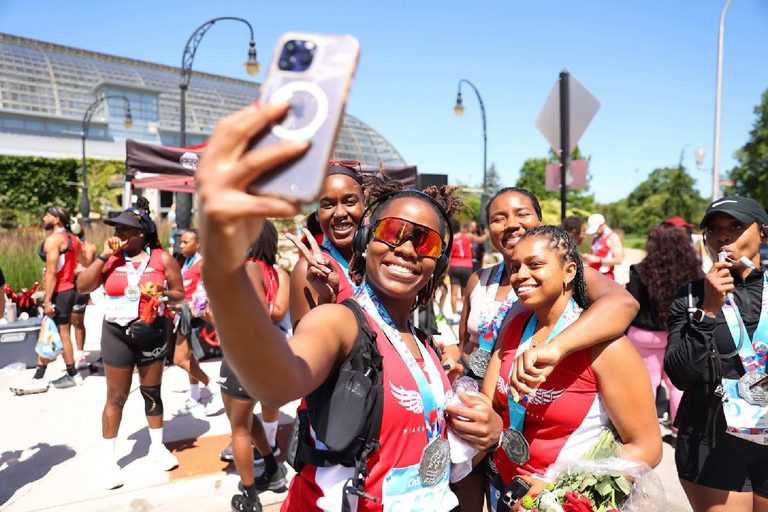
East Garfield Park‑based nonprofit Peace Runners 773 is turning heads on the Chicago Marathon course this Sunday. The group will have a sizable presence at Mile 16, near Jackson and Racine, and 60 of its primarily Black members will line up at the start line.
West Side pride on display
Founder and executive director Jackie Hoffman says the cheering station is a chance to showcase West Side pride and change the narrative about who runs in Chicago. “When people run the marathon, the different cheer zones are like a voice for that community,” she explained.
Peace Runners was founded in 2020 to narrow health and opportunity gaps on the West Side. Its weekend runs regularly draw more than 100 participants to the Gold Dome field house in Garfield Park, and earlier this year the group opened a studio offering nutrition workshops and health programs for youth and older neighbors.
Study confirms health and economic gains
A pioneering study commissioned by the club and conducted by two Kent State University professors was released in August. Researchers followed 111 members of the Out West Run training program from January through the Bank of America Chicago 13.1 half marathon in June.
Survey results showed participants’ average depression‑screening score fell 2.6 points on a 24‑point scale, moving from the mild to the minimal symptom range. A sense of neighborhood belonging rose 51 percent, with respondents strongly agreeing they felt personal ownership of their community.
Economically, the study estimated that physical improvements added about 40 minutes of productive work each week – roughly $1,390 in earnings per year. Better mental health was linked to an additional $3,200 in annual earnings, and meeting CDC activity guidelines for the first time saved an estimated $2,040 in health‑care costs.
Family‑wide ripple effects
Wiggins, a co‑author, highlighted “network effects”: many participants brought spouses, children and aging parents into the program, extending health benefits throughout their households. While the study did not quantify these secondary gains, researchers noted that healthier family members can reduce caregiving burdens and increase overall productivity.
Camille Powell, Peace Runners’ family and youth program manager, will lead a group of five teenagers in the marathon. “If you’re not as stressed at work, you’re going to perform better,” she said, noting the personal and professional payoff of better health.
Member stories illustrate impact
Jeannie Douglas, a 56‑year‑old human‑resources supervisor from Humboldt Park, joined the club in 2024 to help her son meet a school fitness requirement. After losing 35 pounds, she reported relief from sleep apnea, a promotion at work, and a raise she attributes to improved sleep and focus.
“It’s wonderful to feel like this,” Douglas said. “It makes you want to give back and help others who might be feeling the same way I did.”
Peace Runners aims to send runners to all seven World Marathon Majors by year’s end, including events in Sydney, London, Tokyo and New York City, turning local fitness into global representation.
Looking ahead
Hoffman believes the club’s model can serve as a blueprint for other neighborhoods seeking to build health, economic stability and community cohesion through running. “It’s bigger than us, and it’s even bigger than Chicago,” she said.
As the marathon unfolds, the West Side’s cheering station will remind spectators that a simple step on the sidewalk can lead to measurable health improvements, stronger families and a more vibrant local economy.
Original reporting: Block Club Chicago — read the source article.