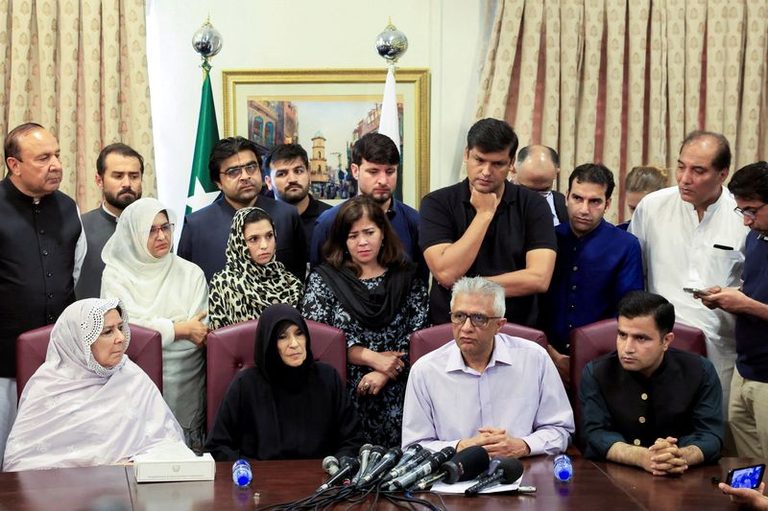
In a development that could reignite public unrest, the Pakistan Tehreek‑e‑Insaf (PTI) party filed a contempt petition on Saturday against senior members of the federal government. The petition claims the authorities violated a Supreme Court order that required former prime minister Imran Khan, who remains incarcerated, to be transferred from Adiala Jail to the private Shifa International Hospital in Islamabad for a medical assessment.
Petition targets top officials
According to PTI legal adviser Naeem Panjutha, the filing seeks action against the prime minister, the law minister, the information minister, and other officials involved in the decision. The petition also demands that Khan receive treatment at the private facility as mandated by the court.
Government’s deviation from the court order
Instead of complying with the three‑judge bench’s directive issued on Tuesday, officials moved Khan on Friday night to the state‑run Pakistan Institute of Medical Sciences (PIMS) for a brief check‑up. He was returned to Adiala Jail after the examination, and PTI alleges that Khan was denied access to his personal physician, a breach of the court’s instructions.
The PTI interprets the court’s order as requiring Khan to remain under medical supervision at the private hospital until at least mid‑September, a timeline the party says the government has ignored.
Family claims of mistreatment
Khan’s sister, Uzma Khan, who accompanied him to PIMS, told reporters that her brother is physically fit but “has told me that he is being repeatedly tortured in prison.” The interior and law ministries, as well as jail officials, have not responded to Reuters’ request for comment on the alleged mistreatment.
Government’s justification
Information Minister Attaullah Tarar defended the decision, stating that security risks necessitated the examination at the state facility. He did not address the broader accusations of contempt or the claim that the move violated the court’s order.
Potential for renewed protests
Khan, who retains significant popular support across Pakistan, was arrested in August 2023 on charges he describes as politically motivated following a fallout with the powerful military establishment that led to his removal from office. His detention sparked nationwide protests, including incidents where demonstrators stormed military installations.
PTI leaders warned that the recent episode could intensify pressure on the government and boost preparations for a planned protest march scheduled for September 27. Supporters gathered on the streets of Islamabad overnight, underscoring the volatile political climate surrounding Khan’s imprisonment.
Legal and constitutional implications
The contempt petition raises questions about the balance of power between the judiciary and the executive, as well as the rights of a detained political leader to receive medical care as ordered by the courts. If the petition proceeds, it could set a precedent for how court orders are enforced in politically sensitive cases.
Observers note that the case highlights broader concerns about the rule of law in Pakistan, the independence of the judiciary, and the role of the military in shaping political outcomes. The outcome of the petition may influence future interactions between the government and opposition parties, especially in a nation where public demonstrations have historically played a decisive role in political change.
Original reporting: Appleton, WI News Feed (HLL/CB) — read the source article.