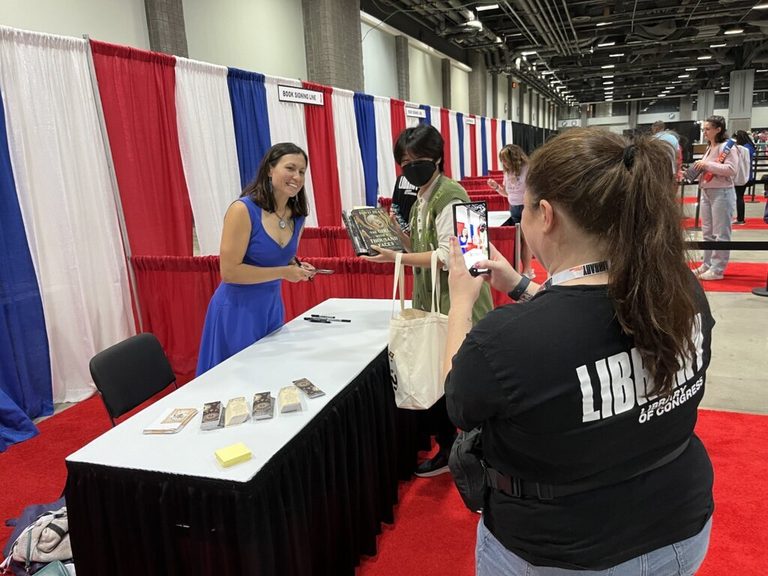
Washington, D.C. — The Library of Congress hosted the 26th annual National Book Festival on Saturday, welcoming over 80,000 registrants to celebrate books, authors, and the art of storytelling. The event featured more than 80 authors offering signings, lectures, and moderated conversations.
Local debut novelist takes the stage
Among the featured writers was D.C. native Bsrat Mezghebe, who attended the festival for years as a reader and returned this time as a published author. Mezghebe’s debut novel, I Hope You Find What You’re Looking For, is fictional but rooted in her experiences growing up in the District. “I am thrilled. I am honored,” she said, adding that the book draws on the real‑life characters and neighborhoods that shaped her.
Mezghebe praised the festival’s atmosphere as a reminder that long‑form storytelling remains vibrant despite the prevalence of smartphones and social media. “We’re all still here, we’re all still reading, and we still care about ideas presented in longer form, not just rapid sound bites,” she explained.
Preserving cultural history through books
Renowned interpreter of the American Popular Songbook Michael Feinstein used his appearance to discuss the broader mission of preserving American cultural history. Feinstein, co‑author of Liza Minnelli’s bestselling memoir Kids, Wait ‘Til You Hear This!, emphasized that books serve as lasting vessels for personal and collective memory.
He reflected on his early work with lyricist Ira Gershwin, noting how physical artifacts—such as Gershwin’s black book of contacts and a tie clip—bring historical figures to life. “Everything to me is about preservation and continuity,” Feinstein said.
Feinstein also recounted a recent visit to Berlin’s memorial for Nazi book burnings, observing that many works survive even after attempts at destruction. “Sometimes there’s one surviving copy that has somehow made it past destruction,” he remarked.
International perspective on the festival
British author Sunyi Dean attended the National Book Festival for the first time and expressed a wish that the United Kingdom host a similar public celebration of literature. “It’s eye‑opening to see what can happen when a country makes a public celebration of literature,” Dean said, adding that the event highlighted the sense of community among readers.
Dean noted that seeing tens of thousands of people gather around books reinforced the idea that readers form a larger, supportive community, even when they do not meet in person regularly.
Community impact
For many attendees, the festival offered a rare chance to meet authors face‑to‑face, sign books, and discuss ideas in person. Mezghebe described the experience as especially meaningful after years of attending as a reader. “So much of book writing is solitary, so it’s nice to be able to look people in the face, to sign their books, and maybe have a conversation about what they’ve read,” she said.
Overall, the National Book Festival turned Washington, D.C. into a temporary hub for readers, writers, and the stories that connect them, underscoring the enduring power of books to bring people together.
Original reporting: Alexandria, VA News – WTOP News — read the source article.