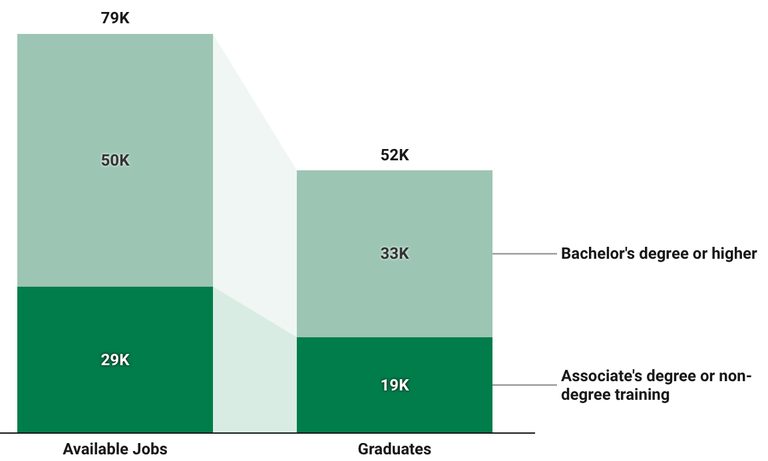
Oregon’s own higher‑education coordination commission released a sobering analysis this week: the state is graduating roughly 26,000 fewer workers with a college credential than the annual demand for such jobs. That gap represents the size of an entire Oregon town of Grants Pass, leaving thousands of well‑paying positions unfilled.
Why the pipeline is narrowing
The report links the shortfall to a stagnant population. A declining birthrate and slower in‑migration mean fewer children entering elementary schools, which ultimately translates into fewer high‑school graduates pursuing college. Only half of Oregon’s high‑school seniors enroll in post‑secondary education within a year, compared with a national average of 58%.
State employers generate about 78,000 openings each year that require a higher‑education credential, yet Oregon’s colleges and universities award just 52,000 degrees annually. Former state economist Mark McMullen notes that historically Oregon could attract out‑of‑state students to fill the gap, but enrollment from other states has fallen over the past decade, making it harder to rely on that “brain‑gain.”
Funding and tuition pressures
Oregon ranks 46th nationally for higher‑education funding. To compensate for limited state support, public institutions charge tuition that rivals or exceeds neighboring states. For the 2026‑27 academic year, in‑state tuition ranges from $11,920 at Eastern Oregon University to $17,508 at the University of Oregon. Community‑college tuition sits around $4,100 for residents and $6,900 for out‑of‑state students, still far above California’s $1,200 in‑state rate.
Mary Moller, executive director of the Coalition of Oregon Public Universities, says the high cost creates a “real barrier for students and families,” forcing many to consider out‑of‑state options that are more affordable.
Degree completion challenges
More than 825,000 Oregonians have attended a college or university without ever earning a degree, the highest proportion in the nation according to the National Student Clearinghouse. This attrition reduces both institutional revenue and the pool of qualified workers for the state economy.
Universities such as Eastern Oregon University and Oregon State University are experimenting with flexible learning pathways to help these students persist, but the report stresses that broader systemic support is needed.
Graduate retention issues
Even when students graduate, many leave the state. Roughly 55% of University of Oregon graduates and 48% of Oregon State University alumni move elsewhere, citing better job prospects in other states. In contrast, community‑college graduates stay in Oregon at a rate of about 75%.
Healthcare workforce bottlenecks
The report highlights a specific mismatch in the health sector. While registered nursing is the second‑most in‑demand bachelor‑level career, Oregon ranks near the bottom nationally for producing nursing graduates, sitting at 47th per capita. Low salaries for nurse educators further restrict the pipeline, creating a bottleneck that limits the number of new nurses entering the workforce.
Moller concludes that “governance changes alone will not solve the problems our institutions are facing.” She calls for increased funding and targeted reforms to align education outcomes with Oregon’s critical workforce needs.
What’s next?
Governor Tina Kotek’s Prosperity Council has already flagged the misalignment between education, training, and industry as a barrier to economic growth. The commission’s recommendations, now public, include expanding scholarship programs, incentivizing out‑of‑state students to stay, and boosting support for community colleges.
State legislators and university leaders will need to weigh these proposals as Oregon seeks to close the 26,000‑graduate gap and ensure families have access to the education needed for a thriving economy.
Original reporting: Homepage – Lookout Eugene-Springfield — read the source article.