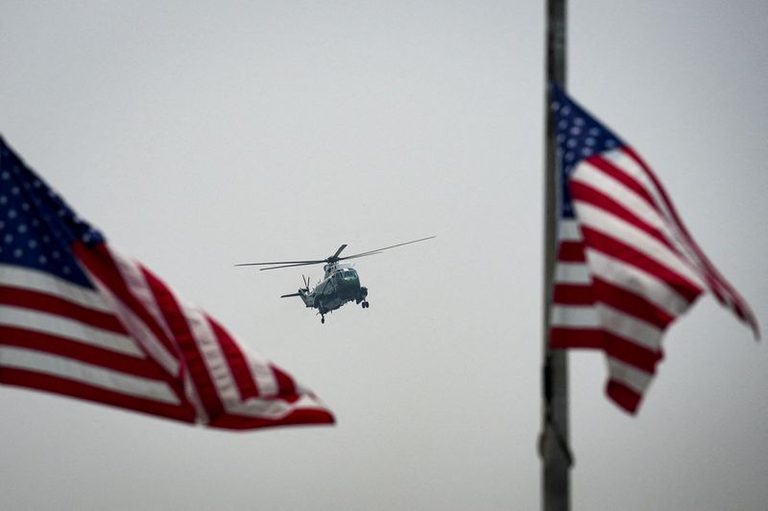
The National Transportation Safety Board (NTSB) released a preliminary report on Thursday detailing a safety incident involving Marine One, the presidential helicopter carrying President Trump. The incident occurred on August 4 as the aircraft was preparing to depart from Reagan Washington National Airport.
Communication breakdown
According to the NTSB, the Marine One crew attempted at least two times to transmit the mandatory three‑minute notice of departure to air traffic controllers. Both attempts were thwarted by communication problems, preventing the crew from confirming clearance before the helicopter left the vicinity of the airport.
While Marine One was in the air, a passenger jet was cleared for departure on a parallel runway. The two aircraft came within a close proximity that raised safety concerns, prompting the NTSB to investigate the sequence of events and the communications failure.
Why the incident matters
Under standard operating procedures, commercial traffic is typically halted when the presidential aircraft is in the immediate airspace to ensure a clear corridor for the President’s movements. The NTSB’s findings suggest that the passenger jet was allowed to depart while Marine One was still nearby, a scenario that is unusual and warrants scrutiny.
Officials from the NTSB emphasized that the investigation is ongoing and that no injuries were reported. The board’s role is to determine whether procedural gaps, equipment issues, or human error contributed to the missed contact with air traffic control.
Response from the administration
White House officials reiterated their confidence in the safety protocols that protect the President’s travel. They noted that the incident does not reflect a systemic problem but rather an isolated communication glitch that is being addressed promptly.
“Our aviation teams work tirelessly to ensure the President’s safety,” a spokesperson said. “We are cooperating fully with the NTSB to resolve any issues and maintain the highest standards of security and efficiency.”
What’s next?
The NTSB will continue its investigation, reviewing flight logs, radio transcripts, and equipment performance. A final report is expected later in the year, which will include recommendations to prevent similar occurrences.
In the meantime, the incident serves as a reminder of the complex coordination required between military flight crews and civilian air traffic controllers, especially when the nation’s leader is on board.
Original reporting: Appleton, WI News Feed (HLL/CB) — read the source article.