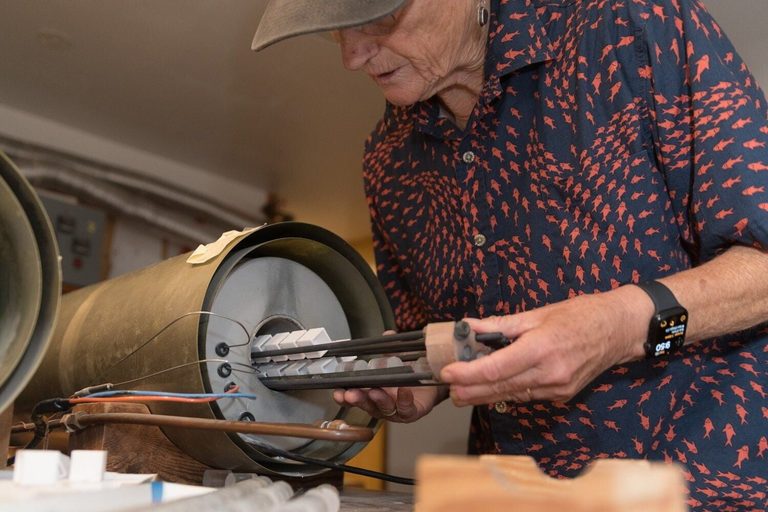
Scientists at the University of California, San Diego’s Scripps Institution of Oceanography have unveiled a breakthrough technique for authenticating ancient pottery. By measuring the temperature needed to erase a specific type of magnetism that accumulates in clay over centuries, the method can reliably tell genuine artifacts from modern copies.
How the test works
When clay is fired, magnetic particles within the material align with Earth’s magnetic field at that moment. Larger particles lock this direction permanently (thermal remanent magnetism), while smaller particles continue to respond to the field over time, creating viscous remanent magnetism. The researchers discovered that the viscous component can be removed by reheating the pottery, and the temperature required rises with the age of the piece.
In laboratory trials, samples older than 1,000 years only lost their viscous magnetization at temperatures above 112 °C, whereas modern or recently made pottery shed it at lower temperatures. The team confirmed the finding by testing known ancient shards, souvenir items from Jerusalem, and confirmed forgeries.
Why it matters
The new approach, detailed in the journal Proceedings of the National Academy of Sciences, gives museums, archaeologists, historians, and law‑enforcement agencies a scientific basis for challenging dubious artifacts. It could also serve as courtroom evidence in cases involving illicit antiquities trade, a problem that spans regions from Israel to China and Mexico.
“I hope that our new method will be useful for museum curators, who wish to display only authentic artifacts, for archaeologists and historians, studying the societies which created them and for law‑enforcement authorities in their effort to eliminate illicit antiquities trade,” said study leader Yoav Vaknin.
Future applications
Beyond museum collections, the technique may aid governments in protecting cultural heritage and help prosecutors secure convictions when forgers attempt to profit from counterfeit relics. As computing power continues to grow, the researchers anticipate even more precise magnetic models to further refine the test.
Original reporting: KTBS 3 (Shreveport) — read the source article.