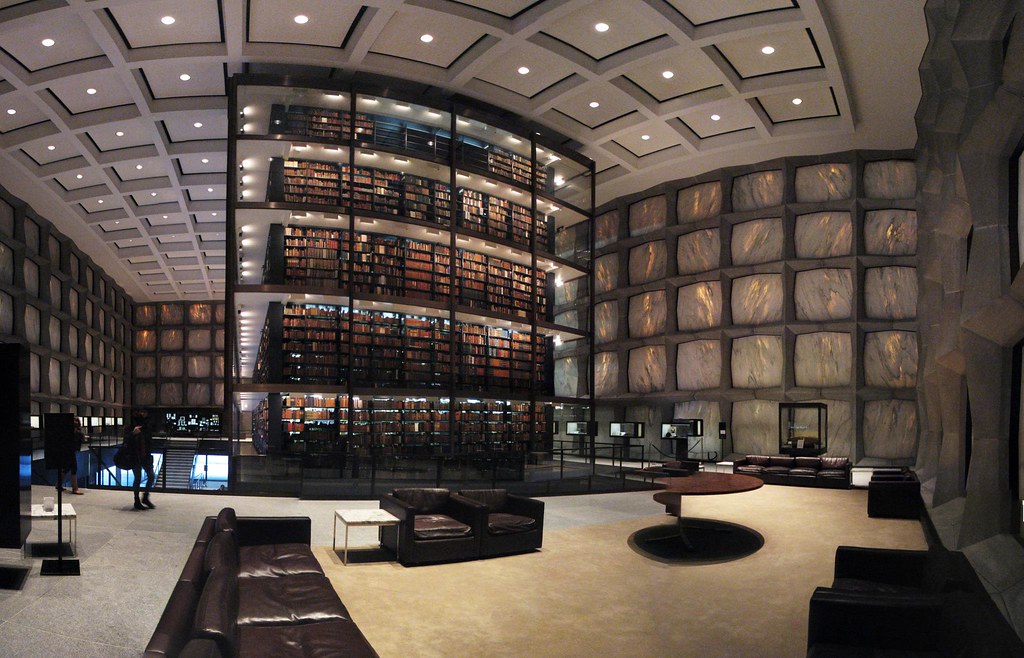
There are buildings you walk past, and then there are buildings that stop you dead in your tracks. The Beinecke Rare Book & Manuscript Library, sitting at the heart of Yale University’s campus on Wall Street in downtown New Haven, is firmly in the second category. From the outside, it looks like something conjured from a dream — a monumental cube clad entirely in translucent Vermont marble panels that glow a warm amber in the afternoon sun, as if the whole structure is quietly lit from within. And in a sense, it is.
Step inside and the effect is even more breathtaking. The interior reveals a six-story glass tower of books rising through the center of the building — thousands of rare volumes stacked floor to ceiling, visible but sealed in a climate-controlled case that protects them from light and humidity. It is one of the most visually arresting rooms I have ever stood in, and I have visited a lot of rooms. There is something almost sacred about it, the way the light filters through those marble walls and falls softly across centuries of human thought.
What makes the Beinecke truly special, beyond the architecture, is that it is one of the largest buildings in the world dedicated entirely to rare books and manuscripts. Yale’s collection here spans more than a million volumes and several million manuscripts, and the library holds some of the most significant objects in the history of Western civilization. A Gutenberg Bible. Original Audubon bird illustrations. Handwritten manuscripts from Langston Hughes, Gertrude Stein, and Tennessee Williams. These are not reproductions behind thick glass — they are the real things, and the curators rotate selections regularly so there is nearly always something new on display in the free public exhibitions on the ground floor.
Admission is completely free, which still surprises me every time I walk through the door. The library is open to the general public Monday through Saturday, and the exhibitions are thoughtfully installed with clear, engaging explanations that make the material accessible whether you are a scholar or simply a curious visitor who wandered off the New Haven Green. The building itself sits adjacent to Hewitt Quadrangle, a sunken marble courtyard with a sculpture garden featuring works by Isamu Noguchi — another entirely free treat that most visitors somehow miss.
Plan to spend at least an hour here, though you may find yourself staying longer. Bring a camera, because the light inside changes beautifully throughout the day. Go on a weekday morning if you prefer a quieter experience, though even on busy afternoons the space retains an atmosphere of calm that feels like a genuine antidote to the noise of modern life.
New Haven has no shortage of remarkable things to discover, but the Beinecke has a way of making visitors feel, however briefly, connected to the long sweep of human history. That is not something you find every day — and it is absolutely worth the trip.