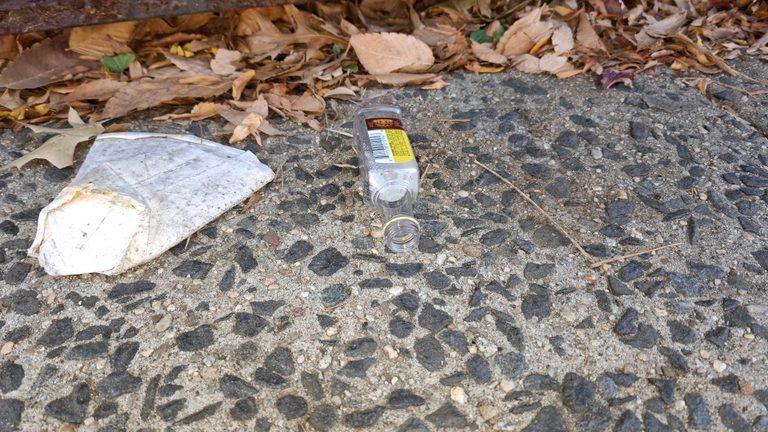
New Haven city officials are pressing the state for the authority to ban “nips,” the tiny liquor bottles that have become a nuisance on sidewalks, parks and public spaces. On Thursday, the Board of Alders City Services and Environmental Policy (CSEP) Committee voted 6‑0 for a resolution urging the Connecticut General Assembly to pass enabling legislation that would allow municipalities to prohibit the sale of these containers.
Legal questions and city counsel’s view
Corporation Counsel Allison Jacobs told the Independent that the issue is still unsettled. “This is a legal question that requires additional review and, to my knowledge, this use case is not something the city has ever seriously studied or considered in the past,” Jacobs said in a statement.
Statutory basis for municipal action
Section 7‑148 of the Connecticut General Statutes grants cities and towns the power to protect and improve the environment and to regulate or prohibit any business that is “prejudicial to public health” or creates an “unreasonable annoyance” to neighbors, provided the action is consistent with state law. If a court interprets that language to cover nips, New Haven could act without new state legislation.
In a 2008 Supreme Court case involving New Haven’s rental‑licensing program, the court read municipal powers broadly, noting that a local ordinance conflicts with state law only when it “prohibits that which the statute authorizes.” Because alcohol sales are licensed by the state, CSEP Committee Chair Anna Festa believes the statute does not extend to liquor sales. “The state statute, I believe, does not cover alcohol‑related sales. So it would have to be a separate law,” she said.
Mayor and state officials weigh in
Mayor Justin Elicker expressed support for municipal authority, whether granted by existing law or new legislation. “Regulating and prohibiting the sale of nips would certainly fall into that category of items I think municipalities should be empowered to address,” he said. He also called the litter “unsightly and unneighborly” and urged both buyers and sellers to take responsibility for proper disposal.
State Rep. Roland Lemar, who co‑chaired the legislature’s General Law Committee, echoed the uncertainty. “I think if the city really wants that, they should ask to have a state law passed and we should debate that at the state level,” Lemar said. He cautioned that the alcohol industry views a ban as a potential violation of existing law and added that he prefers regulatory structures over outright bans, emphasizing the rights of consenting adults.
Environmental advocates’ perspective
Environmental advocate Laura Cahn, one of the resolution’s sponsors, admitted she is not familiar with the specific statutory language but believes municipalities need clear, enabling legislation to avoid costly legal battles. “The state tends to take a ‘conservative with a small c’ approach to laws like this, so it helps if we get specific requests to pass specific legislation that is absolutely clear in its intent,” she said.
Cahn also noted that the city’s current anti‑litter program has not eliminated the problem. She observed fresh nips littering Edgewood Park and the area near Claire’s Corner Copia on Chapel Street.
Funding and city spending on nip cleanup
Since the nickel‑per‑nip program began in 2021, New Haven has received $1,121,343 from the state. City spokesperson Lenny Speiller said about $320,000—roughly 28 percent—has been spent on a part‑time recycling educator, neighborhood clean‑ups and supplies. The remaining funds are earmarked for future projects such as upgraded street‑sweeping signage.
Next steps
The resolution now moves to the full Board of Alders for further review and a potential final vote. If the state grants municipalities the authority to ban nips, the city would hold a public hearing before any ordinance is adopted, allowing residents to weigh in based on testimony and data.
New Haven’s effort reflects a broader conversation across Connecticut about local control, environmental stewardship and the balance between state regulation and municipal autonomy.
Original reporting: New Haven Independent — read the source article.