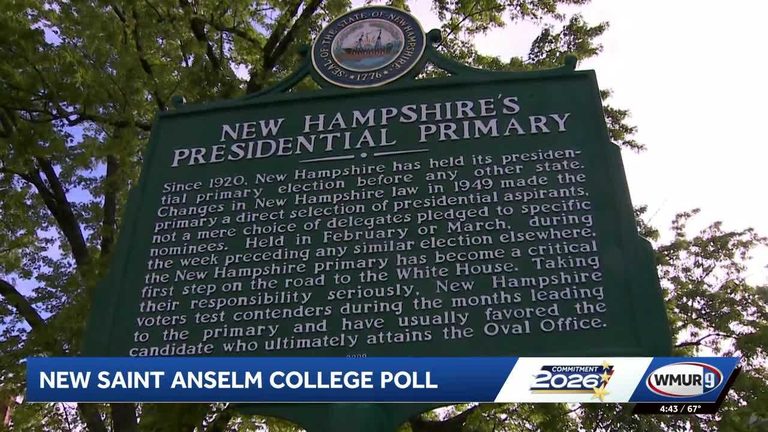
The latest Saint Anselm College Survey Center poll, conducted on Oct. 19‑20 among 1,672 likely New Hampshire voters, offers a snapshot of the emerging 2028 presidential landscape. On the Republican side, Vice President J.D. Vance and Secretary of State Marco Rubio each hold 38% support, with 11% of respondents still undecided about their preferred GOP candidate.
Republican field shows clear front‑runners
Vance and Rubio’s tie suggests a competitive primary that could invite additional candidates to test the waters in New Hampshire, a state known for its early influence on the nomination process. “These are obviously the two front‑runners for the Republican nomination, although I think it’s going to open the door for other candidates to come into the state and campaign for president,” said Neil Levesque of the New Hampshire Institute of Politics. He added that the tie “must make for some interesting West Wing meetings.” Other potential Republican contenders remain in the single‑digit range.
Democratic contenders led by Buttigieg
Among Democrats, former Secretary of Transportation Pete Buttigieg leads with 28% support. He is followed by U.S. Senator Jon Ossoff at 14%, Senator Mark Kelly at 11%, and Representative Alexandria Ocasio‑Cortez at 10%. Former Governor Gavin Newsom, former Vice President Kamala Harris, and Governor J.B. Pritzker each register between 3% and 8%.
Several additional Democratic names appear at the 1%‑2% level, indicating a broad field that could narrow as the race progresses.
Methodology and margins of error
The poll’s Democratic question carries a margin of sampling error of ±3.5%, while the Republican question’s margin is ±3.6%. These figures reflect the inherent uncertainty of any single‑snapshot survey but provide a useful baseline for gauging voter sentiment ahead of the next election cycle.
Implications for New Hampshire voters
New Hampshire’s early primary status means these numbers will be closely watched by national campaigns and local activists alike. The tight Republican race may spur additional fundraising and ground‑game efforts in the Granite State, while the Democratic field’s spread suggests that candidates will need to build broader coalitions to secure the nomination.
For local voters, the poll underscores the importance of early engagement. As the 2028 election approaches, staying informed about candidate positions on issues that matter to families, faith communities, and individual liberty will be crucial.
What’s next?
Political analysts expect more polls to follow as candidates announce formal campaigns and begin touring the state. Voters should watch for upcoming town‑hall events, candidate forums, and grassroots outreach efforts that will shape the final picture of the 2028 presidential contests.
Original reporting: WMUR (Hearst) – local news — read the source article.