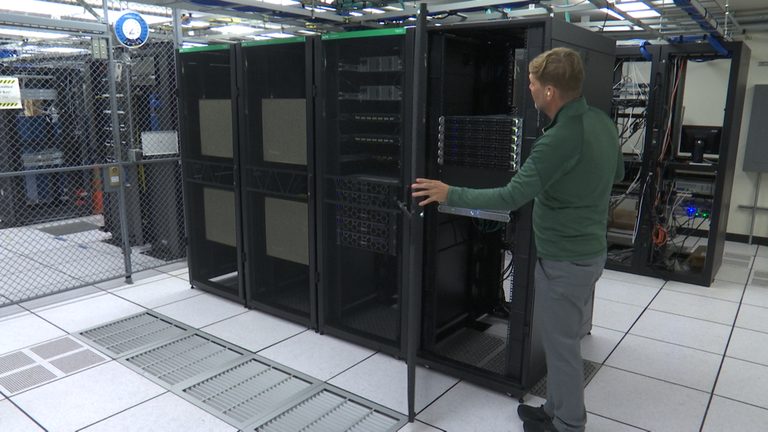
San Luis Obispo, Calif. – On Thursday Cal Poly hosted its annual AI Day, a full‑day showcase of artificial‑intelligence research, industry partnerships, and student projects. The centerpiece of the event was the public unveiling of the university’s new $3 million “AI Factory,” a high‑performance supercomputer housed in the Computer Science building.
Hands‑on learning for the next generation
“AI Day is the third in a series of events that started about a year ago, where people at Cal Poly come together,” said Franz Kurfess, a computer‑science professor. “We talk about what’s going on at Cal Poly in the area of artificial intelligence.” The day featured faculty presentations, student research displays, and an AI Immersion Lab that demonstrated the breadth of AI applications.
Fourth‑year environmental‑engineering student Ashley Lowe praised the technology’s potential, noting, “I think this is great. AI can be used in a bunch of different ways. There are so many applications.” She also cautioned that the environmental footprint of AI systems must be considered, especially water and land usage.
AI Factory’s capabilities and purpose
The AI Factory is powered by NVIDIA hardware and was funded through the Robert Noyce Trust. According to Ryan Matteson, Cal Poly’s technology and training director, the system gives students and faculty the computing power needed for complex AI projects that would be impossible on standard laptops.
“This is a facility that will allow students and professors to build AI models that are more efficient, effective, or powerful for a specific task,” Matteson explained. “We are focusing on solving public‑good problems, AI for public good—solving the problems that exist here in California and around the world.”
Environmental stewardship built into the design
Matteson emphasized that the university is mindful of the AI Factory’s energy demands. “It’s a very powerful computer and to function it needs cooling and electrical power,” he said. “We are using existing capacity that already was here at Cal Poly, and for cooling we have a number of systems that have been in place that accommodate the fluctuating power demands in California. We also have a solar farm on the edge of campus that provides some of the power, so this is not adding any load—it is replacing older equipment with far greater capability.”
The system has been in limited testing since June and is slated to open to the broader campus community next week, giving students a chance to apply AI to real‑world challenges ranging from environmental modeling to agricultural optimization.
Community impact and future outlook
Cal Poly’s “Learn By Doing” philosophy is at the heart of the AI Factory’s mission. By providing hands‑on access to cutting‑edge technology, the university aims to prepare graduates for a job market increasingly driven by AI and data science. Local industry partners attended the event, signaling potential collaborations that could translate campus research into regional economic growth.
“We are the best possible neighbor we can be on power usage,” Matteson added, underscoring the university’s commitment to responsible stewardship while expanding its technological capabilities.
The AI Factory represents a significant investment in the future of education and innovation in San Luis Obispo, positioning Cal Poly as a hub for AI research that balances technological advancement with environmental responsibility.
Original reporting: KEYT (Ventura/Santa Barbara) — read the source article.