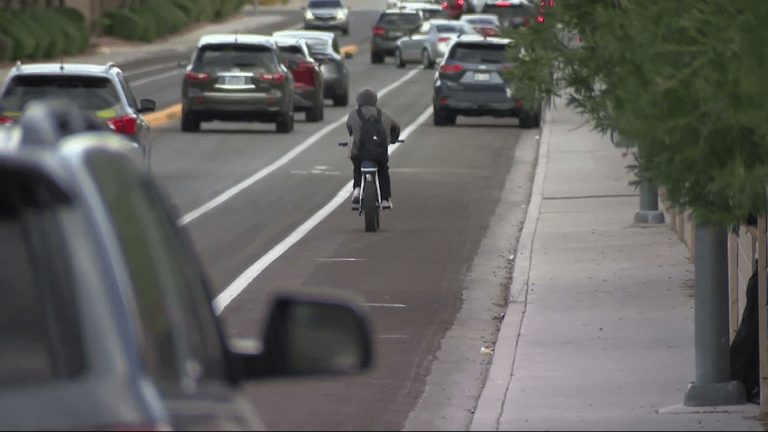
Clark County officials are moving quickly to address a surge in traffic accidents involving electric scooters and electric bikes, especially among students traveling to and from school. Police data show that 122 students have been hit by cars since the start of the school year, and 69 of those students – 57% – were riding an e‑scooter or e‑bike at the time of the collision.
Police and safety advocates sound the alarm
Metro Police Officer Robert Wicks explained that the department’s Fatal Team is seeing more incidents involving e‑devices each day. “We’re seeing these e‑motorcycles that are being sold online. They’re designed for trails and off‑roading, but they end up on our streets at high speeds,” he said. Wicks added that many teens are riding devices they are not legally permitted to use, and that some adults mistakenly think an e‑bike is the same as a slower‑moving scooter.
Local traffic‑safety advocates echo the police concerns. Krista Holloway, founder of Walk Safely LV, argued that parents should be held liable when a minor is injured on an e‑ride. “If a kid does something wrong on an e‑ride and they’re under 18, the parents should definitely be held responsible because they gave it to them,” Holloway said.
Parents call for more education and oversight
Parents in the community are already voicing frustration. “I’m not surprised,” said Misti Goncz, a mother of a student who was injured. “You see a lot of cars trying to pull out, and kids are just coming full speed.” Goncz and other parents are urging schools and law‑enforcement to provide clearer guidance on safe riding practices.
Officer Wicks stressed the need for public education. “You’re gonna have to continue to educate the public, educate the community, to educate the parents on what they’re buying their child and then making sure that their child is riding these devices safely,” he said.
County leaders propose new ordinances and state legislation
Clark County Commission Chairman Michael Naft said every municipality in Southern Nevada is working on ordinances that address e‑devices in a positive way. “Our police departments throughout the community are working on education and enforcement of those ordinances,” Naft explained.
Naft outlined plans to push for state legislation in the upcoming legislative session. He emphasized that future laws should focus less on classification and more on speed limits and tamper‑proof technology. “It will be less about classification, more about speed, more about ensuring that these devices can’t be altered to increase their performance,” he said.
Both Naft and Holloway agree that age limits are essential. “If you’re riding something that can go 30 miles an hour, you should have a permit. You should have a license,” Holloway said. Nevada currently requires riders of Class 3 e‑bikes – which assist up to 28 mph – to be at least 16 years old, but there is no minimum‑age rule for e‑scooters.
Data shows mixed responsibility
Police records indicate that in half of the student‑involved incidents, the student was at fault. Advocates stress that this underscores the need for both driver vigilance and rider education. “It’s another reminder for students and drivers to pay attention and follow the laws so everyone makes it home safely,” a Metro Police spokesperson said.
What families can do now
While officials work on new rules, families can take immediate steps to protect their children:
- Ensure any e‑device purchased complies with Nevada’s speed and registration requirements.
- Enroll children in a safety course that covers traffic laws, helmet use, and proper riding techniques.
- Monitor riding locations and set clear boundaries for where high‑speed devices may be used.
- Advocate for school‑district policies that include e‑device safety in transportation plans.
By combining stricter ordinances, targeted education, and parental responsibility, Clark County hopes to reduce the number of e‑device accidents and keep students safe on their way to school.
Original reporting: News 3 KSNV Las Vegas (local) — read the source article.