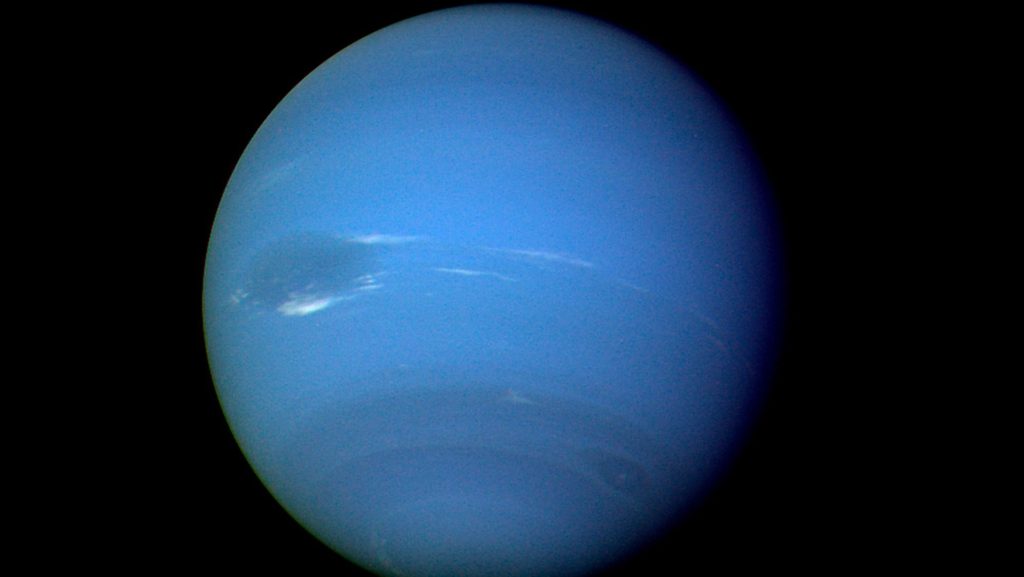
Neptune’s oddball moon Nereid is getting a second look after observations with the Webb Space Telescope by a team led at the California Institute of Technology suggest it might be one of the planet’s original satellites that escaped a cosmic cleanup. The study, led by Matthew Belyakov of Caltech and published in Science Advances, puts Nereid, Voyager 2’s lone planetary neighbor visits, and Gerard Kuiper’s discovery all in the same story. Scott Sheppard of Carnegie Science also weighed in, reinforcing the idea that Nereid’s history may trace back to Neptune’s early days.
Nereid is small by planetary standards, roughly 220 miles across, but its orbit is anything but ordinary. The moon follows a highly eccentric path that takes almost a full Earth year to circle Neptune, swinging from about 1 million miles out to nearly 6 million miles on the far end of its elongated loop. That extreme orbit has long been a clue that something dramatic shaped its past.
The Webb telescope’s infrared eyes allowed the team to probe Nereid’s surface composition, and what they found didn’t line up with Kuiper Belt objects that formed farther out. Nereid shows a higher ice content than typical trans-Neptunian objects, a hint that it did not wander in from the distant frozen belt. That compositional mismatch is the key piece of evidence pushing the idea that Nereid formed in Neptune’s neighborhood rather than being a late capture.
Triton, Neptune’s giant captured moon, is central to the whole narrative because its arrival would have been catastrophic for any original satellites. When Triton was snared by Neptune’s gravity billions of years ago, its capture likely sent former moons onto collision courses and scattered survivors into wildly different orbits. The picture researchers paint is one of a violent reshuffling that left only fragments and a few eccentric survivors like Nereid.
“What we know about Nereid is very limited. For its size, Nereid is extremely understudied,” Matthew Belyakov said, pointing out just how little direct data exists beyond the Voyager 2 snapshot and remote telescope work. Voyager 2’s 1989 flyby remains the only in-person visit to Neptune, leaving most of the system’s history to be inferred from telescopes and theory. Gerard Kuiper’s original discovery of Nereid about four decades before Voyager adds historical weight but not much detail.
Belyakov’s team argues that Nereid’s ice-rich signature and its eccentric orbit are consistent with an origin near Neptune, followed by orbital reshaping after Triton’s capture. “We don’t have all that much evidence left around Neptune — the system doesn’t have very many moons left,” Belyakov said in an email. He and colleagues suggest the innermost moons we see today could be the broken remainders of the originals that didn’t survive Triton’s arrival.
Outside experts seem intrigued. Scott Sheppard called the Webb results “an exciting result” and noted the orbital behavior fits the story of a moon that might have formed close to Neptune and then been pushed outward by Triton’s capture. The consistency between surface composition and dynamical expectations strengthens the case that Nereid is a survivor rather than a latecomer. That alignment of observations and theory is precisely what planetary scientists look for when reconstructing chaotic early histories.
Comparisons to the rest of the solar system put Neptune’s sparse entourage in context: Saturn leads with 292 known moons, and Jupiter and Uranus also host many more satellites than Neptune’s modest complement. The relative lack of leftovers around Neptune is another clue that something disruptive wiped the slate mostly clean. If Triton’s capture is the main culprit, it explains why Neptune’s system looks so lean compared with its gas giant cousins.
A direct spacecraft visit could resolve lingering questions about Nereid and the Neptunian system’s past, but no missions to Neptune are currently planned. Remote telescopes like Webb can push our understanding forward, but in situ sampling or close-range imaging would clinch debates about formation and composition. For now, the Webb observations and the interpretations from Belyakov’s team offer the strongest argument yet that Nereid may have survived a cosmic collision course by being shoved into a wild, elliptical orbit instead of being ejected or smashed.