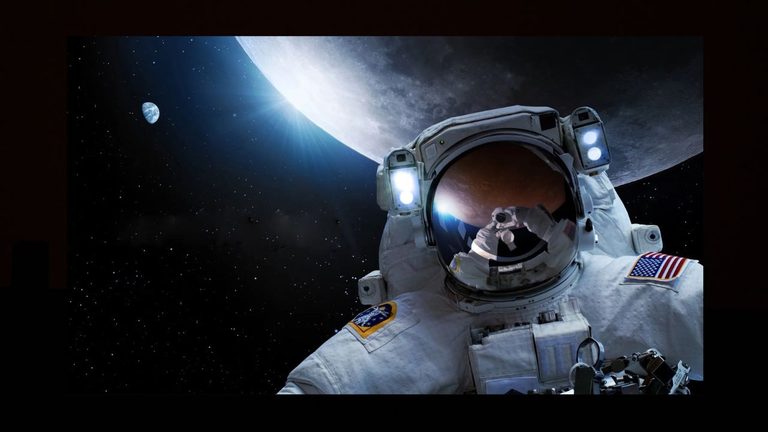
NASA is seeking four volunteers to spend a year living and working in a simulated deep-space mission designed to help prepare astronauts for future trips to the Moon and Mars. The agency announced it is recruiting participants for the first Moon and Mars Exploration Analog (MMEA) mission, which is scheduled to begin no earlier than August 2027 at NASA’s Johnson Space Center in Houston.
Simulation Details
The yearlong study will place crew members in isolated, confined environments that simulate interplanetary travel and planetary surface operations. Researchers will study how participants adapt to the physical and psychological demands of long-duration missions while testing technologies and procedures that could support future human exploration.
Volunteers will begin by living inside a two-story habitat that simulates a spacecraft traveling from Earth to the Moon or Mars. The habitat includes work areas, sleeping quarters, living space, and hygiene facilities. Participants will then move into a 3D-printed surface habitat designed to replicate living on another world.
Throughout the mission, researchers will monitor crew health and performance under conditions that mimic the limited resources and operational demands expected during deep-space exploration. NASA said the findings could help shape future Artemis missions, plans for a sustained lunar presence through its Moon Base initiative, and the first crewed mission to Mars.
Volunteer Requirements
NASA is seeking U.S. citizens or permanent residents between the ages of 30 and 55, although applicants outside that range may also be considered with additional approval. Candidates must be proficient in English, no taller than 74 inches (6 feet, 2 inches), willing to commit to approximately 14 months — including 12 months in isolation and two months of training and post-mission activities — and able to pass NASA’s physical and psychological evaluations.
Applicants must also have a bachelor’s degree in engineering, biological science, physical science, or mathematics, along with relevant professional experience. Advanced STEM degrees and military service may be substituted for some experience requirements. NASA also requires applicants to have strong technical skills, no dietary restrictions, and no history of sleepwalking or using sleeping aids.
Original reporting: The Dallas Express — read the source article.