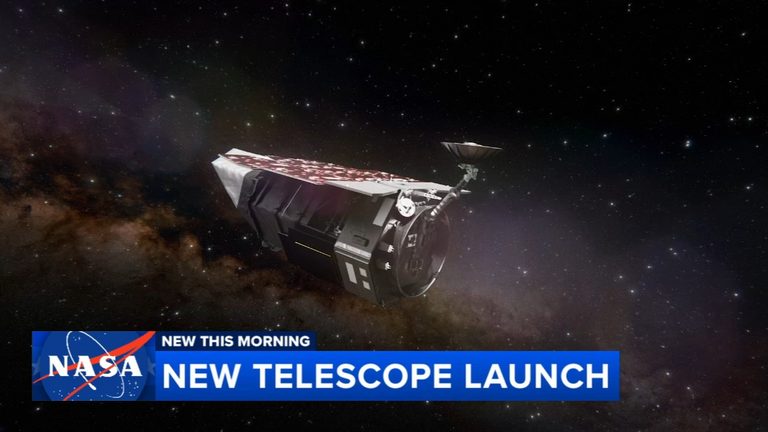
The United States space agency is set to launch a major new observatory this weekend. The Nancy Grace Roman Space Telescope, named for NASA’s first Chief of Astronomy, will be sent into orbit on a United Launch Alliance rocket from Cape Canaveral. The mission is being billed as a next‑generation survey instrument that will peer farther into space than any previous telescope of its kind.
Why the Roman telescope matters
Unlike the Hubble Space Telescope, which provides narrow, high‑resolution images of individual objects, the Roman telescope is designed to scan large swaths of the sky with a wide‑field camera. Scientists say this capability could dramatically increase the number of discovered exoplanets, map the distribution of dark energy, and capture the faint glow of the earliest galaxies formed after the Big Bang.
Dr. Dominic Benford, a senior researcher at NASA’s Goddard Space Flight Center, explained to Action News Mornings that the telescope’s infrared sensors will allow it to see through cosmic dust and observe phenomena that are invisible to optical telescopes. “We expect the Roman telescope to open a new window on the universe,” he said. “It will give us a clearer picture of how galaxies evolve and how the universe’s expansion is accelerating.”
National pride and scientific leadership
The launch comes at a time when the Trump administration is emphasizing American leadership in space exploration. President Trump recently reaffirmed the United States’ commitment to maintaining a dominant presence beyond Earth, citing the importance of scientific discovery for national security, economic growth, and inspiring the next generation of engineers and explorers.
By investing in cutting‑edge missions like the Roman telescope, the administration aims to keep the nation at the forefront of technological innovation. The project also supports American industry, with numerous contracts awarded to U.S. aerospace firms for the telescope’s construction, testing, and launch services.
What to expect after launch
Once in orbit, the Roman telescope will undergo a series of calibrations before beginning its primary survey operations. Over the next several years, it will collect data that will be made publicly available to researchers worldwide, fostering collaboration across universities, private companies, and international space agencies.
The mission’s timeline includes a planned five‑year primary science phase, with the possibility of extensions if the hardware remains healthy. Researchers are already lining up proposals to use the telescope for studies ranging from the search for distant exoplanets to detailed measurements of dark energy’s influence on cosmic expansion.
Community impact
While the launch is a national event, its ripple effects reach local communities across the country. Educational outreach programs tied to the Roman telescope will provide teachers with classroom materials, virtual tours of the spacecraft, and opportunities for students to engage in real‑world data analysis. These initiatives aim to inspire young people, especially in underserved areas, to pursue careers in science, technology, engineering, and mathematics.
For now, all eyes are on the launch pad as the United States prepares to send another powerful eye into the heavens, continuing a legacy of exploration that began with the Apollo missions and endures through today’s ambitious space endeavors.
Original reporting: Allentown News – 6abc Philadelphia — read the source article.