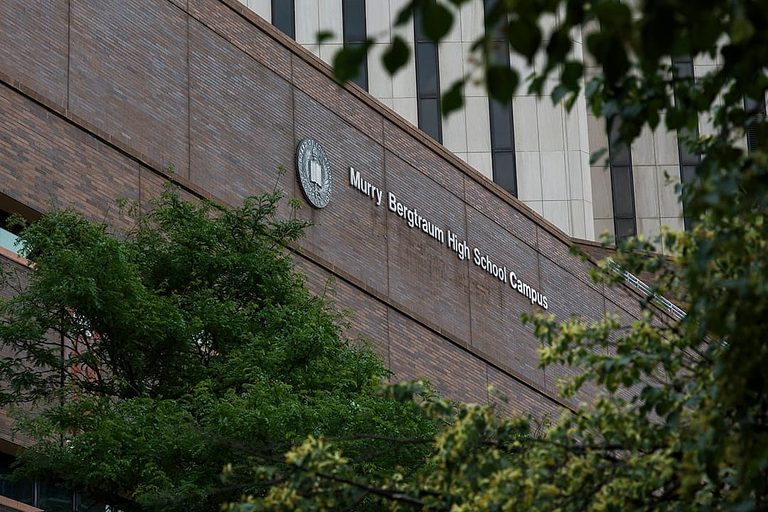
On the fourth floor of a fortress‑like campus in lower Manhattan, four public high schools share space, but Murry Bergtraum High School for Business Careers sits largely empty. With roughly 90 students, it is the city’s smallest traditional high school and offers no extracurriculars beyond the sports programs run by its sister schools.
Funding and staffing gaps
Last year the school received more than $46,000 per student, about double the citywide average. Yet its lone math teacher cannot cover every required class, forcing some seniors to attend night school at other campuses. “When you look at the other schools, it’s mad people, mad opportunities,” said recent graduate Christopher Vasquez. “But when you come to our school, really nothing.”
Decades of decline
Founded in 1975 as the nation’s first high school focused on business careers, Murry Bergtraum once enrolled 3,000 students and ranked among the city’s top performers. Over the past two decades enrollment has plummeted, and the school now ranks in the bottom 1 % for four‑year graduation rates and attendance.
Former Manhattan high‑school superintendent Vivian Orlen, who oversaw the school from 2018 to 2022, said she repeatedly proposed closing or merging the school, but the Education Department showed “no appetite” for the idea. “What we all know about what kids deserve is not happening there,” Orlen said.
Citywide trend of under‑enrolled schools
Chalkbeat data show that 33 New York City high schools now have fewer than 150 students, and 113 have fewer than 250—a roughly eightfold increase from 25 years ago. The Education Department has acknowledged the problem but has not announced a comprehensive plan to address it.
Competing schools on the same campus
Since 2013, three other schools have moved into the same building: Urban Assembly Early College High School for Emergency Medicine (basement), Urban Assembly Maker Academy (fourth floor), and Manhattan Early College High School for Advertising (third floor). Each now offers 42‑52 courses, while Murry Bergtraum offers only 23.
The competition, combined with citywide enrollment declines, has made recovery nearly impossible. In 2022 the school’s principal and the Education Department declined to answer specific questions about the school’s future.
Calls for action
Former deputy chancellor Karin Goldmark, who oversaw school closures under former Mayor Bill de Blasio, noted that crises often delay hard decisions. “It’s almost impossible for a school that size to serve students well,” she said.
Under Mayor Eric Adams, the school was repeatedly discussed in internal conversations about chronically under‑enrolled schools, but the administration focused on opening new schools rather than consolidating existing ones.
Eight years after Orlen first pushed for closure, she remains dismayed that the school stays open. “It is institutional failure,” she said.
Student experience today
Class sizes average 15 students, yet three‑quarters of students missed at least 18 days of school last year. Some eighth‑graders applied by mistake, confusing the campus schools, while others transferred in after disciplinary issues elsewhere.
Despite the challenges, the campus as a whole provides unique opportunities: a hydroponic farm, 3D printers, an ambulance simulator, and pathways to associate degrees. Those programs thrive in the other schools, highlighting the stark contrast with Murry Bergtraum’s limited offerings.
City officials have yet to present a clear plan to either revitalize Murry Bergtraum or responsibly consolidate it with the thriving programs nearby.
Original reporting: KEYT (Ventura/Santa Barbara) — read the source article.