The Democratic Republic of the Congo is wrestling with an Ebola outbreak that has moved fast and rough, hitting communities and health workers alike in places like Ituri Province and Bunia. Mercy Corps country director Rose Tchwenko, Médecins Sans Frontières operations lead Alan Gonzalez, International Medical Corps president Ky Luu, and Save the Children country director Greg Ramm are all working on the front lines. This piece looks at how local beliefs, diagnostic blind spots, a lack of vaccines for the Bundibugyo strain, and violence in the region are complicating efforts to contain the virus.
The first reported case that Mercy Corps staff heard about involved a healthcare worker who was cared for at home instead of at a hospital. “The initial thought for the family, even the patient, was that this was related to traditional practices, or maybe even witchcraft,” said Tchwenko, Congo country director for the humanitarian aid organization Mercy Corps. The man died and was given a traditional burial, which likely spread the virus, and his wife contracted Ebola while tending him.
Misinformation and distrust are major hurdles in affected communities, and that distrust sometimes turns into hostility toward responders. “There are still, unfortunately, a lot of false beliefs around Ebola,” Tchwenko said. “There’s also a lot of suspicion in certain areas around humanitarian actors or government.”
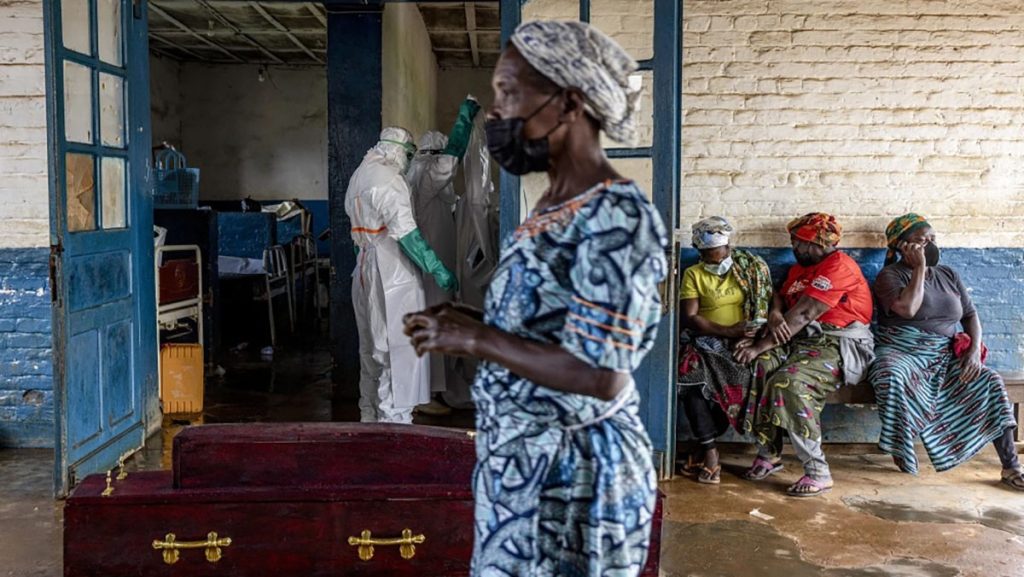
In some towns, anger over how bodies are managed has boiled over into violence, with residents attacking treatment sites after being denied traditional access to corpses. Bodies can remain infectious for days, and traditional funeral practices that involve touching and preparing the dead have repeatedly driven transmission in past outbreaks. Public health teams are trying to balance safe burial practices with cultural sensitivity to avoid further backlash.
The World Health Organization reported hundreds of cases and dozens of deaths as the outbreak grew, and field teams say it spread undetected for weeks. Standard rapid tests that usually flag Ebola were failing to identify this outbreak for a time because the virus at work is the Bundibugyo strain, which those tests do not pick up reliably. Alan Gonzalez explained that local labs were finding Zaire strain positives even though the real culprit was different, so specimens now go to a more distant lab in Kinshasa and that adds days to diagnosis.
There is no proven vaccine or targeted therapeutics for Bundibugyo yet, and that narrows the tools responders can use to break transmission chains. “We don’t have that tool,” Luu said. “We’re kind of back to where we were with the West Africa Ebola outbreak.” In the absence of a vaccine for this strain, health teams are falling back on contact tracing, isolation, and strict infection control to slow spread.
Practical gaps are making those basics harder to deliver. In crowded places like Bunia, isolation wards filled up fast and teams had to repurpose surgical centers into makeshift treatment spaces. “In Bunia, the biggest city in Ituri, places to isolate suspected cases, they are full,” Gonzalez said. With limited beds and protective gear, every suspected patient forces painful choices about where and how to care for them safely.
International assistance is moving but it is racing against time and terrain. The U.S. State Department announced an initial $23 million in foreign assistance to help scale up response efforts, and International Medical Corps has deployed rapid response teams and is preparing to build new facilities. “It’s a race to set up the treatment centers, the screening units,” Luu said. “It’s a race to be able to get supplies into these impacted areas, so you know we’re having to look at sourcing locally for materials, simple things like gowns and gloves and chlorine.”
Donor fatigue and aid cuts have made a hard situation worse, shrinking the humanitarian footprint just when it is needed most. “The amount of humanitarian assistance that’s come into Congo this year compared to two years ago is much less,” Greg Ramm said. “We are working in fewer health centers than we were before. Therefore, we have fewer mobilized community health workers now.” That reduced presence means fewer people doing surveillance and fewer trusted community voices to counter dangerous rumors.
Finally, the outbreak sits inside a complex conflict landscape where access is inconsistent and security risks are constant. “There’s about 100 armed groups that are just fighting for control, so it makes it very, very difficult in order to get access to have appropriate surveillance, and it’s going to be a logistical challenge,” Luu said. The mix of dense population, remote terrain, and ongoing fighting is turning what could be a localized flare into a regional emergency.