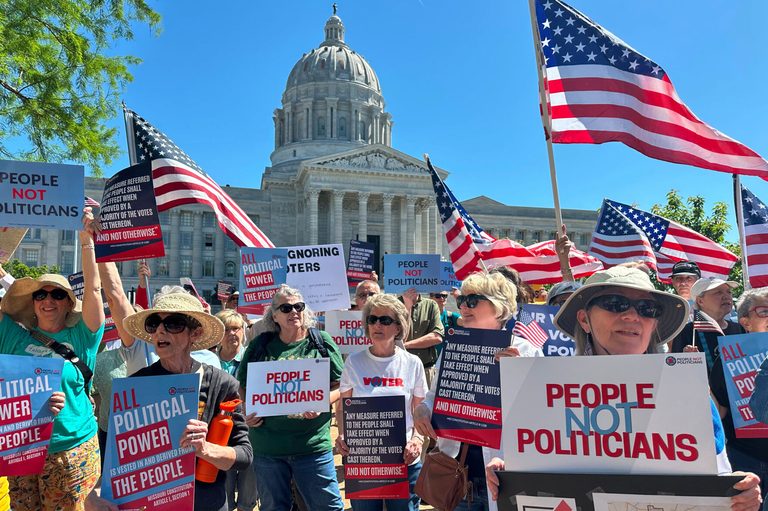
Jefferson City — On Wednesday, Cole County Circuit Judge Daniel Green signed a decision that keeps Missouri’s newly drawn U.S. House districts in place for the November 2026 election. The ruling rejects a petition that sought to place the map before voters in a statewide referendum.
Background on the map
The revised districts were first used in the August primary. Republican Secretary of State Denny Hoskins dismissed the petition, arguing that the Missouri Constitution does not permit a referendum on congressional redistricting. Judge Green agreed, noting that the Constitution is silent on the issue and that the legislature has the exclusive authority to draw congressional lines.
Missouri’s current delegation includes six Republicans and two Democrats, all elected from districts drawn after the 2020 census. Governor Mike Kehoe called a special legislative session last year after President Donald Trump urged Republican‑led states to redraw districts to improve GOP prospects in the midterms.
How the new map favors Republicans
The new configuration reshapes the 5th Congressional District, currently represented by Democrat Emanuel Cleaver of Kansas City. Portions of Kansas City have been moved into two neighboring districts held by Republicans, while the remainder of Cleaver’s district stretches eastward into heavily Republican rural counties. An Associated Press estimate puts the share of new voters in the 5th District at about 59 percent.
State Senator Rick Brattin won the Republican primary in the reshaped district in early August, while Cleaver ran unopposed for the Democratic nomination.
Legal arguments
Republican Attorney General Catherine Hanaway’s office, which represented Secretary of State Hoskins, argued that congressional redistricting is a legislative function not subject to a popular vote without explicit constitutional authorization. The office also warned that changing district lines after the primary would cause widespread voter confusion and erode confidence in the integrity of the state’s elections.
John Gore, an attorney for national Republican committees, echoed those concerns, saying a last‑minute map change would undermine public trust.
Historical context
This is the first time in more than a century that a Missouri redistricting plan has faced a referendum challenge. In 1922, voters rejected a congressional map passed by a Republican‑controlled legislature, but that petition was never contested in court.
National implications
Missouri’s mid‑decade redistricting effort is among the most litigated in the country, with roughly a dozen lawsuits filed over the past year. The state was the second, after Texas, to act on President Trump’s call to redraw districts. Republicans hope the new maps in eight states—including Texas, North Carolina, Ohio, Florida, Tennessee, Louisiana and Alabama—will net up to 16 additional House seats. Democrats project a possible gain of six seats from new maps in California and Utah.
Whether the Missouri map delivers the expected Republican advantage remains uncertain. Historically, the president’s party loses seats in midterm elections, and President Trump’s current approval ratings could pose an additional hurdle for GOP candidates.
Original reporting: KTBS 3 (Shreveport) — read the source article.