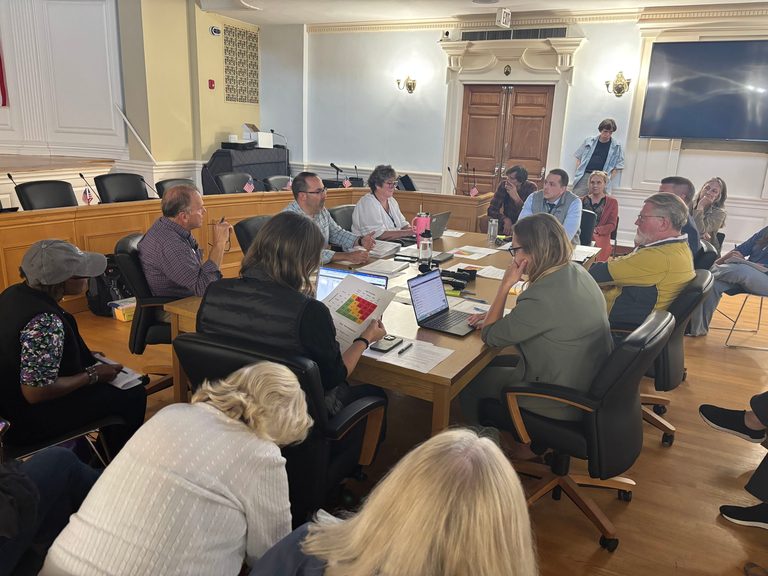
Milford officials have taken a measured step toward addressing community concerns over surveillance technology. The newly created Milford Public Safety Technology Committee met this week to examine the city’s use of Flock license‑plate reader cameras, as well as red‑light cameras, speed cameras, drones and other monitoring devices.
Committee composition and mandate
The six‑member panel includes four residents – James Woyciesjes (D), Sarah Wood (D), John Mager (R) and Scott Barlow (R) – and two aldermen appointed by the mayor, Alder Win Smith III (R) and Alder Meghan Brennan (D). Police Chief Keith Mello serves as a non‑voting member. The group is charged with gathering information, questioning the vendor Flock Safety and the police department, and ultimately recommending whether the city should keep the cameras, shut them down or impose additional restrictions.
Background of the pause
In August, the Board of Aldermen voted in a special meeting to pause all red‑light and speed cameras, and to suspend every Flock camera except those positioned at the city’s borders. The pause followed weeks of heated public debate. Opponents raised concerns about data‑privacy, the length of time Flock retains video and license‑plate information, and the potential for data sharing with other law‑enforcement agencies. Supporters argued that the technology helps police identify suspects, make arrests and keep neighborhoods safe.
Public voices
Residents voiced strong opinions at the August meeting. “We’re demanding you take these cameras out ASAP,” said Tony DeBlase, a Milford citizen. In contrast, Nancy Austin defended the equipment, stating, “The police need the technology. Everything is advancing in this day and age. First and foremost, they need to be safe to protect us.”
Key questions under review
During the latest session, committee members drafted a list of questions for the police department and Flock Safety. Topics include data‑security safeguards, data‑retention policies, and whether the cameras can be configured to capture only license plates flagged in an FBI criminal database. The panel also discussed Boston’s recent decision to end its trial with Flock after discovering a setting that allowed other law‑enforcement agencies to access its data, a breach of the city’s contract.
Next steps
Chair James Woyciesjes emphasized the committee’s intent to gather as much information as possible before forming a recommendation. “How do we implement these technologies with the right partners and vendors, so they’re done in the right way that we make the community safer and not infringe on any rights,” he said.
The committee’s findings are expected within 60 to 90 days. Its next public meeting is scheduled for November 10. While the meeting will be open to the public, there is no formal comment period; residents who wish to voice concerns are instructed to contact their city alder, who will relay messages to the committee.
Balancing safety and privacy
Milford officials say the review aims to balance support for law‑enforcement effectiveness with residents’ legitimate privacy worries. By involving community members from both parties and providing a transparent process, the city hopes to reach a solution that upholds public safety without compromising constitutional rights.
Original reporting: NBC Connecticut — read the source article.