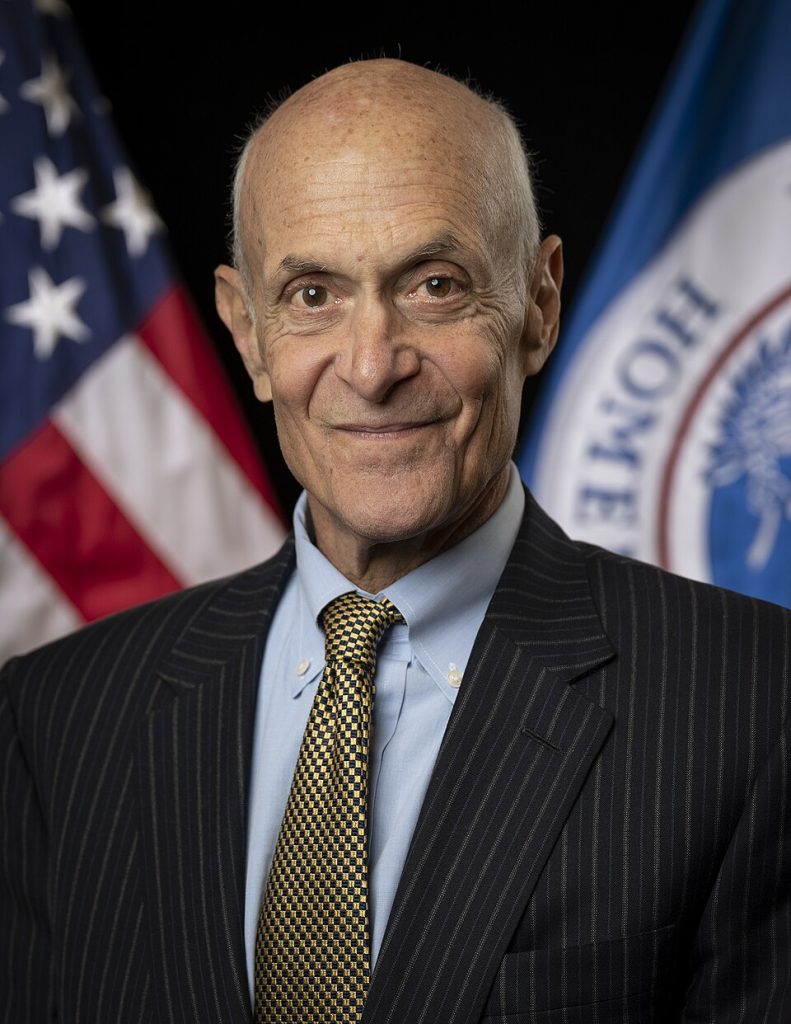
Michael Chertoff, born November 28, 1953 in Elizabeth, New Jersey, is a Harvard‑educated lawyer who rose to national prominence through a series of high‑profile legal and security positions. After graduating with a BA in 1975 and a JD in 1978, he clerked for Judge Murray Gurfein on the U.S. Court of Appeals for the Second Circuit and then for Justice William Brennan on the U.S. Supreme Court.
Early Legal Career
Chertoff began as an associate at Latham & Watkins in Washington, D.C. (1980‑1983) before serving as an Assistant U.S. Attorney for the Southern District of New York (1983‑1987). He earned the Department of Justice’s John Marshall award in 1987 and later became First Assistant U.S. Attorney for the District of New Jersey (1987‑1990) and U.S. Attorney for that district (1990‑1994).
Government Service and the Patriot Act
From 1994 to 1996, Chertoff acted as special counsel for the Senate Whitewater Committee. He returned to the Justice Department as Assistant Attorney General for the Criminal Division (2001‑2003) and helped draft the Patriot Act after the September 11 attacks. In 2003, President George W. Bush appointed him to the U.S. Court of Appeals for the Third Circuit, where he served until 2005.
Secretary of Homeland Security
President Bush nominated Chertoff as the second Secretary of Homeland Security, a role he held from February 15, 2005 to January 21, 2009. During his tenure, he oversaw the department’s response to natural disasters, immigration enforcement, and counter‑terrorism initiatives.
Post‑Government Career
After leaving DHS, Chertoff joined Covington & Burling LLP as senior counsel and co‑founded the Chertoff Group, a global security advisory firm. He served as chairman of the board of directors of BAE Systems, Inc. from May 2012 until December 2021. In 2022, he was named co‑chair of a Homeland Security Advisory Council subcommittee that recommended ending the Disinformation Governance Board.
Recent Activities
In early 2023, CNN reported that the Supreme Court had not disclosed a longstanding financial relationship with Chertoff, despite citing him as an independent security expert. Chertoff later provided a public accounting of his firm’s work for the Court, which began five years earlier and includes security for justices’ homes, travel, and courtroom operations.
Chertoff’s career reflects a blend of legal expertise, national security leadership, and private‑sector advisory work, positioning him as a notable figure in contemporary American security policy.
Original reporting: KRDO (Colorado Springs metro) — read the source article.