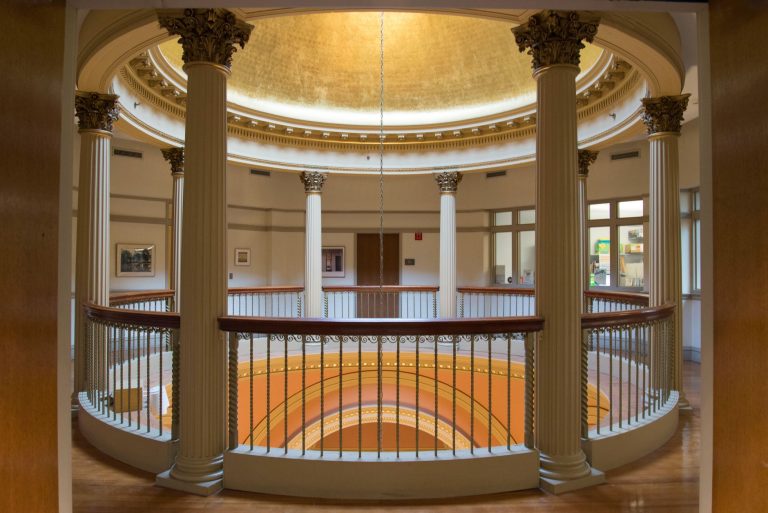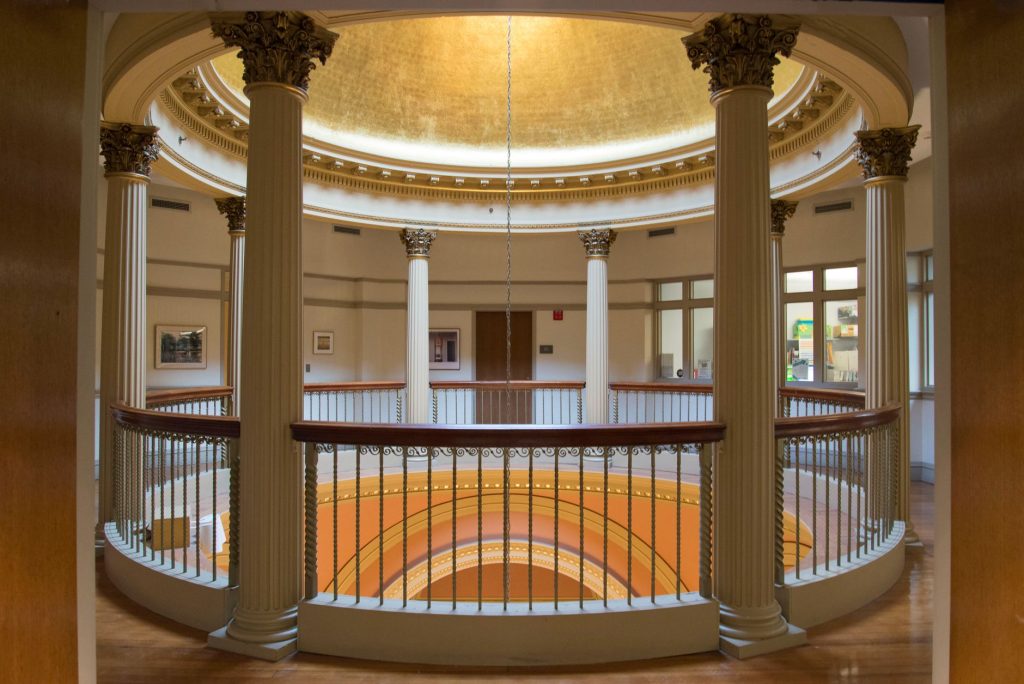
On a Tuesday afternoon in late October, the Joseloff Gallery sits almost perfectly quiet. A security attendant turns a page. Two students stand close to a large-format photograph, speaking in low voices about shadow and contrast. The light from the clerestory windows falls flat and even across the walls. It is exactly the kind of place where looking actually happens.
The Joseloff Gallery occupies a compact but well-proportioned space inside the University of Hartford’s Mortensen Library building, on Bloomfield Avenue in Hartford’s Northwest end — close enough to West Hartford Center to draw visitors from that direction, far enough that most people passing through never think to stop. The gallery is free and open to the public, which puts it in a category of civic good that the city does not advertise nearly enough.
What distinguishes Joseloff from the bigger institutions in town is what it chooses not to do. There is no permanent collection to manage, no survey exhibition of impressionism to satisfy a broad audience. The programming rotates through contemporary work — photography, sculpture, mixed media, video installation — almost always by artists with serious regional or national footing. Past shows have featured emerging photographers with gallery representation in New York alongside established Connecticut printmakers who have been working for forty years. The curatorial instinct runs toward specificity: the gallery picks a thing and commits to it.
Exhibits typically run six to eight weeks, and the gallery mounts four to five shows per academic year. That calendar means there is usually something new up between September and May, with a quieter summer schedule. Checking the University of Hartford arts calendar before making the trip is worthwhile — the gallery does occasionally close between installations, and walking up to a dark room is a disappointment that is easily avoided.
The scale of the space works in its favor. With roughly 1,500 square feet of exhibition area, nothing here competes with itself. A photographer showing large inkjet prints on aluminum gets the room they need. A sculptor working with industrial materials does not feel cramped into corners. Visitors who have spent years feeling overwhelmed by encyclopedic museums often find that the Joseloff’s containment is actually a relief — there is a beginning, a middle, and an end, and an hour is enough to do it properly.
Admission is free, parking is available on the university lots on weekdays with a permit or in metered spaces on Bloomfield Avenue, and the surrounding campus has a few spots to sit and decompress afterward. The University’s Lincoln Theater is nearby, and the broader arts complex on that side of campus makes a combined afternoon visit feel coherent rather than cobbled together.
For anyone who follows contemporary photography or printmaking and has exhausted the rotating shows at the Wadsworth, the Joseloff runs on a different track entirely — different artists, different priorities, different sense of what an exhibition should do. The city has two serious institutions operating at once. That is not something most mid-sized cities can say.