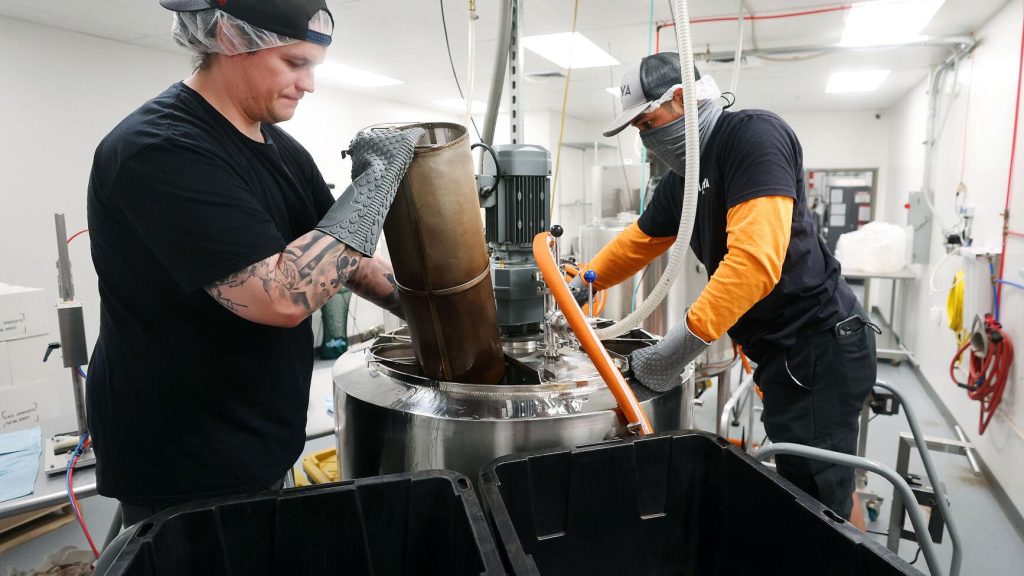
Inside a cavernous warehouse on North Flowing Wells Road, a room full of shiny, kettle-like vats looks more like a small craft distillery than a tea distributor’s workspace. Those vessels are the centerpiece of a new operation turning tea into a line of non-alcoholic craft spirits, produced alongside the company’s long-running tea business.
The project grew out of the company’s decades-long tea work and the founder’s interest in creating alcohol-free alternatives that capture familiar spirit flavors. Using blends of steeped tea, spices and aromatics, the team recreates profiles reminiscent of gin, rum, whiskey and mezcal while steering clear of alcohol. The products are sold under the Philters label with intentionally altered spellings — Ruhm, Wiski, Mezkahl and Jynn — and are built to deliver flavor and a mild lift through added adaptogens and nootropics rather than ethanol.
On the production floor, workers add ingredients such as chicory and oak chips to impart smokiness and depth, then steep the mixtures and move them through bottling and cooling before labeling. The cooking and steeping process fills the room with strong aromas, and staff often wear protective coverings while handling batches. The maker says these zero-proof blends can be made and distributed much faster than traditional aged spirits — a process that typically requires years — allowing for quick turnaround on orders.
The non-alcoholic line was conceived as a response to requests from food-service customers — particularly coffee shops and restaurants — that wanted a non-caffeinated, night-time beverage offering without the need for a liquor license. Development began before the pandemic, stalled and restarted several times, and then accelerated as the maker had time to refine recipes and processes while other business lines slowed.
Market interest in alcohol-free beverages has surged in recent years. Nationwide sales recently topped the billion-dollar mark, driven largely by non-alcoholic beer, while spirits alternatives and mocktails have been among the fastest-growing segments. That trend has encouraged wider curiosity among consumers, especially younger adults who are more likely to explore sober-curious options.
The founder says demand is emerging not only locally but around the country, with interest from independent cafes, coffee chains and other retailers. The products are being offered through the company’s own outlets and a handful of local shops, and the team views the line as a boutique niche with room to grow as more venues look for alcohol-free choices that still deliver complex, familiar flavors.