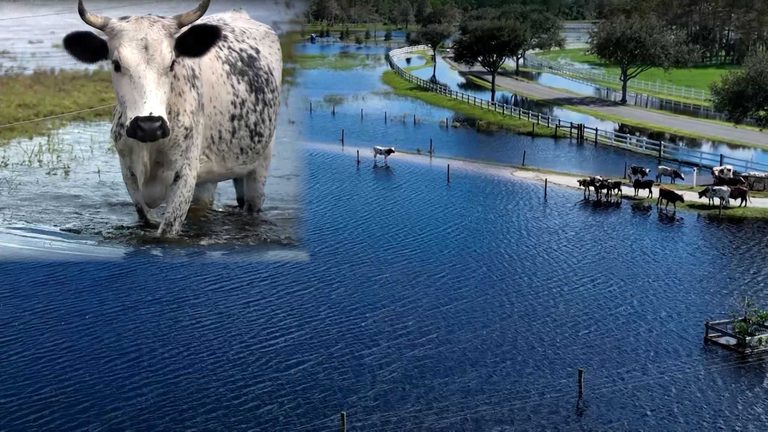
Recent flooding in Martin County continues to inundate residential neighborhoods and agricultural land, leaving cattle farmers and homeowners scrambling for solutions. The Trailhead community, a subdivision of the Trailside Homeowners Association, reports that water from adjacent properties is overwhelming its drainage system, while nearby farms struggle to keep livestock safe.
Farmers face rising water on pasture
Hungryland Farms, a 20‑acre rotational grazing operation for Florida Cracker cattle, has seen much of its pasture submerged. Owner Melissa explained that the water forced the herd onto the farm’s elevated driveway, threatening both access and animal health.
“We’re starting to lose big sections of the driveway. We have them concentrated up the house pad, but if we lose too much more, we’re just going to have to figure out a way to evacuate them somewhere,” Melissa said.
To keep the herd fed, the farm is bringing in hay and hay cubes while monitoring for potential health risks from the floodwaters. Melissa also noted that the farm maintains an emergency contact with the U.S. Department of Agriculture’s Natural Resources Conservation Service should the animals face imminent danger.
Homeowners association warns of overwhelmed infrastructure
Kyla Shay, president of the Trailside Homeowners Association, said the community’s drainage system was designed for water from its 41 lots and designated neighboring parcels. Water from outside the system is now flowing through county‑owned land and other adjacent properties before reaching the community’s southern canal.
“We can handle ours. We can’t handle theirs,” Shay said.
The flooding has also reached areas near Bridge Road and an electrical substation. Some transformers sit partially underwater, and septic systems are submerged, leaving residents unable to shower or do laundry. The county health department issued a warning that standing water could contaminate well water with bacteria.
County says repairs must wait for safer conditions
Martin County officials confirmed that the county recently acquired roughly 315 acres of land known as the Elise J. property in the affected area. A county spokesperson said establishing access to the property is the immediate priority so staff can assess conditions.
The county is working with the Hobe‑St. Lucie Conservancy District to address a breach affecting drainage into an irrigation canal. Both agencies agreed that repairs should wait until water levels recede, as current conditions make hauling and placing sand unsafe and could damage the levee.
“County staff will continue to monitor water levels and site conditions in close coordination with the Hobe‑St. Lucie Conservancy District,” the spokesperson said. The county will move forward with repairs when conditions allow safe work without compromising the levee, and is also evaluating longer‑term options to improve outflow and reduce future flood risk.
Residents look for long‑term solutions
Shay said the homeowners association has been consulting water engineers and other experts to gauge how long the flooding could last. “It’s probably going to be late January, February before we can see a break, and that’s assuming the south canal wall does not collapse and immediately dump all the water on us,” she warned.
Melissa echoed the sentiment, noting that while the farm’s drainage system normally handles seasonal rain, the volume of water from outside the property has overwhelmed it.
Both women emphasized the need for neighboring property owners and responsible agencies to address the drainage problem promptly.
County continues monitoring
For now, Martin County says it will keep monitoring water levels and coordinating with the conservancy district before attempting any repairs. In the meantime, Hungryland Farms remains focused on keeping its cattle safe as water continues to surround the property.
Original reporting: WPBF (Treasure Coast / Hearst) — read the source article.