Mackenzie Park has been a city park since 1935, but most people who drive past it on I-27 think it’s just the place with the prairie dogs. That’s a reasonable assumption and also a significant underestimate.
The prairie dog town is real, and it’s worth a stop — a fenced colony of black-tailed prairie dogs going about their business in a flat, open enclosure near the park’s eastern edge. Kids love it. Adults who haven’t thought about prairie dogs since grade school usually find themselves standing there longer than planned. Admission is free, the animals are wild enough to be interesting, and on a clear weekday morning you might have the place almost to yourself. That’s your first reason to come.
The second is the park’s sheer size. Mackenzie stretches across several hundred acres along the Yellow House Draw, a dry canyon that cuts through the eastern edge of Lubbock in a way that feels genuinely different from the flat grid of the surrounding city. There are paved trails and unpaved ones, and you can get a real walk in — two or three miles without retracing your steps — without ever feeling like you’re circling a parking lot. Early mornings in spring, before the wind picks up, are about as pleasant as Lubbock gets outdoors.
The park also has a disc golf course, which draws a regular crowd of players who know the layout well enough to have opinions about which holes are fair and which ones punish you for overthinking. Equipment is bring-your-own, and the course is free. If you’ve never played, watch a few holes before you start — the wind off the canyon changes everything about the game.
There’s a small amusement area on the west side called Joyland that operated for decades before closing permanently in 2011. The infrastructure is mostly gone now, but the Ferris wheel base and a few remnants are still visible if you know where to look. It gives the park an odd, quiet kind of history — not a ruin exactly, but a reminder that this place has been a destination for a long time.
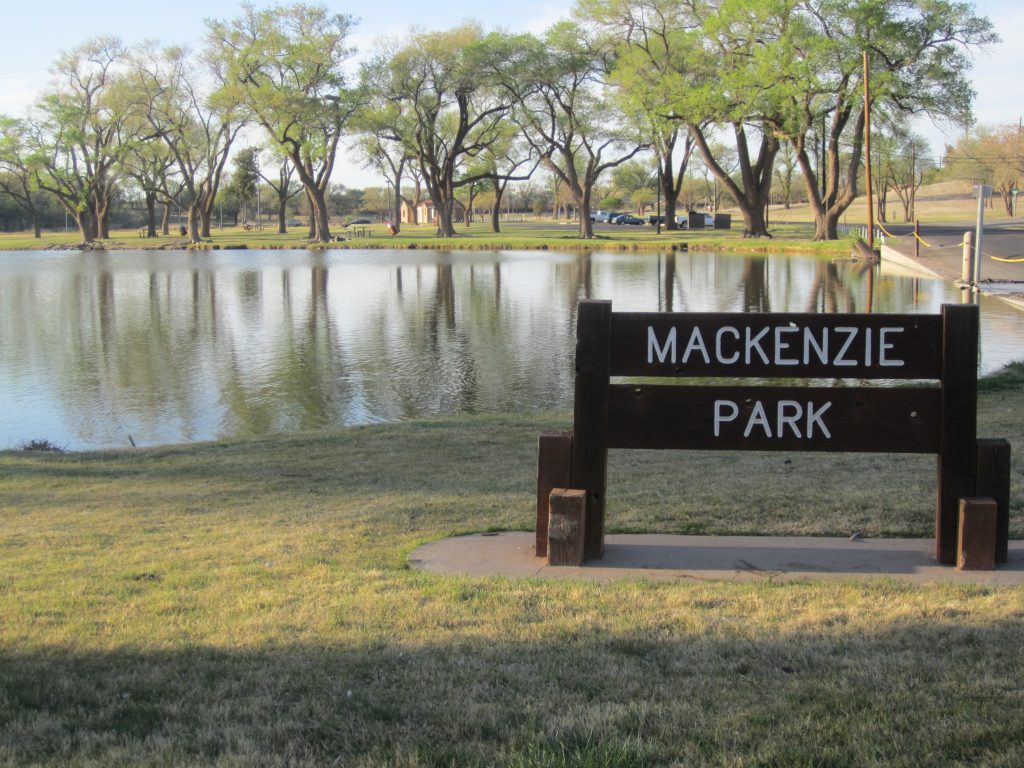
For families, the park has picnic shelters, playgrounds, and a pond where people fish for catfish and bass. A fishing license is required for adults, and you can pick one up at most sporting goods stores in town for a modest day fee. The pond isn’t deep, but it produces fish consistently enough that people come back.
Parking is free throughout, and the park is open daily from sunrise to sunset. There’s no admission gate, no food vendors on most days, so bring water and whatever you’re planning to eat. On weekends in the warmer months, you’ll share the space with birthday parties and soccer practices, but the park is large enough that it rarely feels crowded.
What makes Mackenzie worth knowing isn’t any single feature. It’s that the park functions as a working public space — used daily by runners, dog walkers, disc golfers, and families — without making any particular fuss about itself. In a city that can feel spread thin, it holds together in a way that’s easy to take for granted and worth noticing.