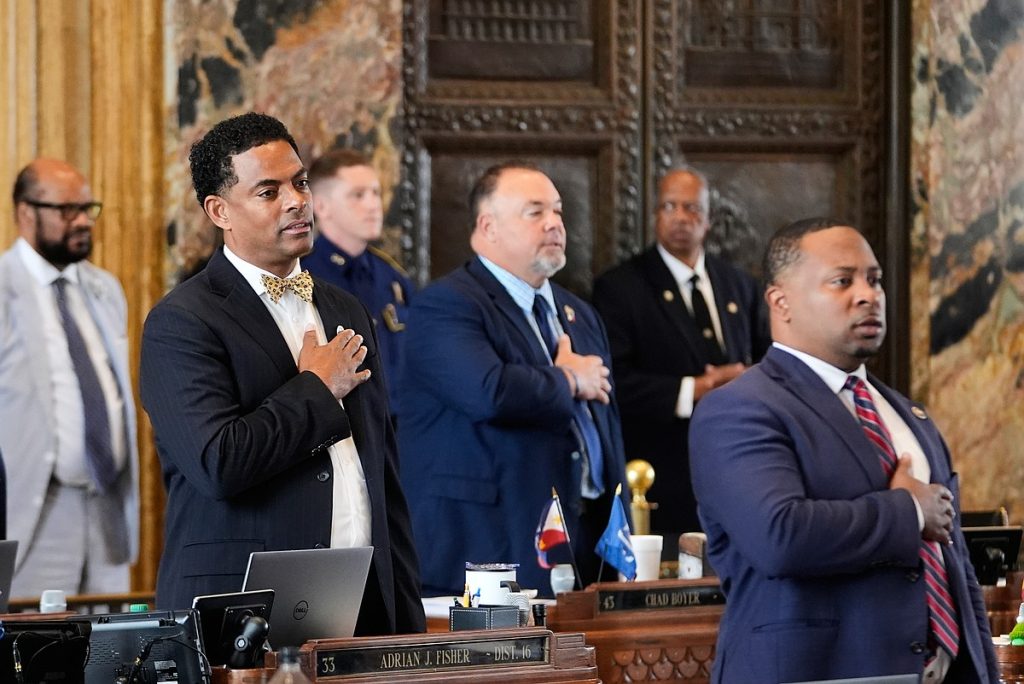
In a significant political development, Louisiana has enacted a new congressional district map designed to enhance Republican representation. Governor Jeff Landry signed the map into law following its passage through the Republican-majority state legislature. This move comes in the wake of the U.S. Supreme Court’s decision to strike down the previous map, which included two majority-Black districts, as an illegal racial gerrymander.
Redistricting and Political Strategy
The newly approved map aims to shift the balance of power by consolidating Black voters, who predominantly support Democrats, into a single district. This strategy is intended to create a 5-1 Republican advantage in the state’s congressional delegation, as opposed to the previous 4-2 split. Republican state Sen. Jay Morris, who sponsored the bill, emphasized that the redistricting was driven by party affiliation rather than racial considerations. He stated that more Democrats were intentionally placed in District 2 to improve Republican performance in other districts.
However, Democratic lawmakers argue that the map is a racially motivated gerrymander. State Sen. Sam Jenkins expressed concerns about potential legal repercussions, while the ACLU of Louisiana has hinted at possible lawsuits, describing the map as a “racial gerrymander hiding behind the thin veneer of partisanship.”
Impact on Local Representation
The redistricting affects the districts of Democratic U.S. Representatives Cleo Fields and Troy Carter. Fields’ district will now encompass predominantly white communities in the Baton Rouge area, while Carter’s district will include parts of Baton Rouge, maintaining its majority-Black composition. The changes have prompted criticism from Democrats, who view the map as an attempt to dilute Black voting power.
The redistricting process in Louisiana reflects a broader trend among Southern states, where Republican-controlled legislatures are redrawing maps following the Supreme Court’s weakening of the Voting Rights Act. While Republicans anticipate gaining up to 15 seats nationwide from these efforts, Democrats are also eyeing potential gains in states like California and Utah.
As the political landscape continues to shift, the legal battles over redistricting are expected to intensify, with implications for the upcoming midterm elections and beyond.
Original reporting: Texarkana Gazette — read the source article.