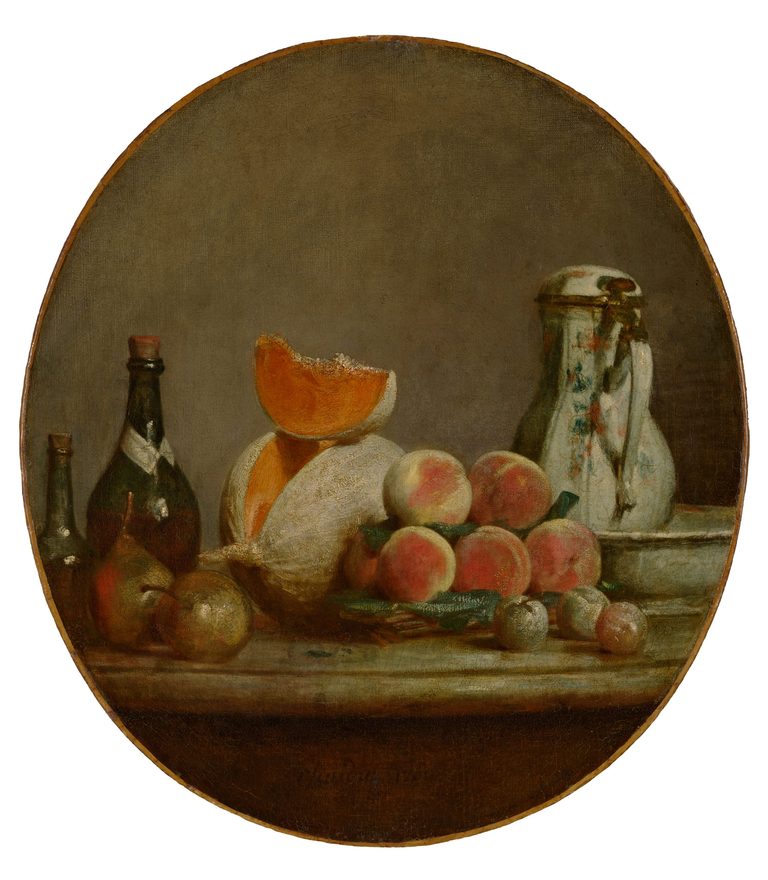
FORT WORTH, Texas – The Kimbell Art Museum announced that Jean Siméon Chardin’s still‑life masterpiece The Cut Melon (1760) is back on view after a meticulous conservation effort that treated both the canvas and its original oval frame. The painting, celebrated as one of Chardin’s finest works, now appears as it did when it debuted at the Paris Salon in 1761.
Restoration Details
Acquired by the museum last year, the work had spent centuries in distinguished private collections before arriving at the Kimbell. Over time, a layer of discolored varnish and decades of gentle neglect dulled the original cool tonality Chardin intended. Conservators removed the varnish, revealing the crisp marble tabletop, the clear pitcher, and the textured cantaloupe rind that contrast with the bright orange flesh. The newly exposed dry‑brush technique on the leaves and the subtle surface texture now convey the tactile quality Chardin sought.
The Original Frame
The oval frame, a rarity for Old Master paintings, was also restored. Historical records show the frame was paired with Chardin’s The Jar of Apricots at the 1761 Salon and was listed as belonging to goldsmith Jacques Roëttiers, who served King Louis XV. Sketches by contemporary artist Gabriel de Saint‑Aubin confirm the frame’s design: a simple neoclassical motif of olive‑leaf branches crossed and tied with a ribbon, flanked by two narrow gilded bands. The frame’s distinctive curb chain – twisted, interlocking links carved in low relief – reflects the goldsmith’s expertise and would have been familiar as a decorative hanging element in the period.
Historical Context
Jacques Roëttiers likely commissioned the painting and its pendant, sharing a close professional relationship with Chardin; both were granted artists’ lodgings in the Louvre by the king. The work later entered the collection of 19th‑century painter François Marcille, whose efforts helped revive interest in Chardin. In 1876, Baroness Charlotte de Rothschild purchased the painting, and it remained in her family until the Kimbell Art Foundation acquired it.
About Jean Siméon Chardin
Born in 1699, Chardin earned the admiration of Enlightenment thinker Denis Diderot, who called him “the great magician.” Accepted into the Académie Royale in 1728, Chardin elevated still‑life and genre painting to a respected status within the French Academy. Former Louvre director Pierre Rosenberg has called The Cut Melon and its pendant “among the finest of this period of Chardin’s career.” Though his reputation waned after his death in 1779, the 19th‑century rediscovery of his work influenced later masters such as Édouard Manet, Paul Cézanne, and Lucien Freud.
Visitor Information
The Kimbell Art Museum welcomes the public to view the restored painting during regular hours. Admission to the permanent collection is always free; special exhibition tickets range from $14 to $18, with discounts for seniors, students, children, teachers, active‑duty military, and SNAP recipients. Audio guides are available for $4, and the museum offers half‑price admission on Tuesdays and after 5 p.m. on Fridays. The museum is open Tuesday‑Thursday and Saturday, 10 a.m.–5 p.m.; Friday, noon–8 p.m.; and Sunday, noon–5 p.m. For more details, call 817‑332‑8451 or visit kimbellart.org.
Original reporting: Fort Worth Report — read the source article.