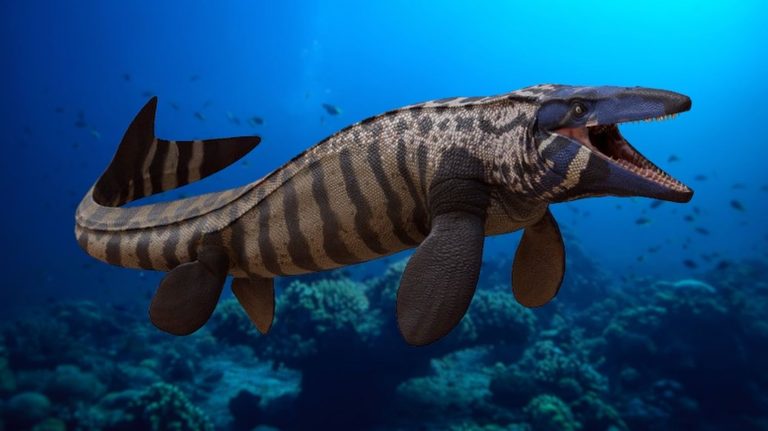
A remarkable discovery was made by 12-year-old Corbin Bullard during a 4-H field trip in Kansas, where he unearthed the fossilized remains of a Tylosaurus, a massive marine reptile from the Cretaceous Period. The find took place at a quarry in Jewell County while Bullard was participating in an outing with the Sedgwick County 4-H Geology Club.
Bullard, who was 11 at the time, spotted several large vertebrae exposed by rock removal operations. His mother, Wendy Bullard, recalled the moment of discovery, noting her son’s excitement upon finding the bones. The fossil was later identified as belonging to a Tylosaurus, a creature that lived when much of the central United States was covered by an inland sea.
The excavation, which required multiple trips by club members, revealed nearly the entire skeleton, including the skull, with only part of the tail missing. The fossil, measuring over 15 feet long, was found in the Smoky Hills Chalk formation, dating back approximately 82 to 87 million years.
Educational Impact of 4-H Programs
The discovery underscores the educational opportunities provided by 4-H programs. Stephanie Hays, Sedgwick County’s 4-H agent, emphasized that 4-H helps children explore their interests and achieve remarkable feats. Club leader Crista Burnett highlighted the broader benefits of 4-H, including public speaking and research skills.
For Bullard, the experience has deepened his interest in paleontology. He is currently preparing the fossil for display at the Sedgwick County Fair, a process that has already taken over 30 hours. The fossil, found on private property with the owner’s permission, belongs to Bullard, and he hopes it will impress judges at the fair.
Wendy Bullard credited the 4-H community and local landowners for making the discovery possible, noting the collaborative effort required. She described 4-H as a community that enables such discoveries through its various branches, including horticulture, art, and livestock.
This find offers a rare glimpse into Kansas’ ancient past and serves as a reminder of the treasures that can still be uncovered beneath the prairie landscape.
Original reporting: The Dallas Express — read the source article.