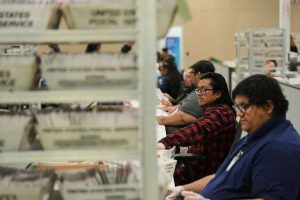
The Justice Department announced that, for the upcoming election, it will deploy about 1,000 election monitors to counties in every state. DOJ spokesperson Kiersten Pels said the monitors will “merely observe” voting locations and forward any suspected violations of federal law to the department for review after Election Day. The administration stresses that the program is designed to protect voters and uphold the rule of law.
Where monitors are headed
While the full list of deployment sites will be released on Election Day, several states have already received notices. In Arkansas, monitors are slated for Pulaski and Washington counties; Georgia will see them in Fulton, DeKalb, Gwinnett, Cobb, Chatham and Bibb counties; Kansas will host monitors in Johnson, Sedgwick and Wyandotte counties; Maine’s Portland and Lewiston are on the list; Massachusetts will see them in Lowell and Boston; New Hampshire’s Manchester and Nashua; Oklahoma’s Oklahoma, Tulsa and Muskogee counties; Pennsylvania’s Philadelphia, Allegheny, Luzerne and Lehigh counties; and South Carolina’s Charleston County. Louisiana’s Deputy Secretary of State Trey Williams said his office was informed indirectly but has not yet received formal notification.
Purpose and legal basis
The DOJ’s election‑monitoring program has existed for decades to ensure compliance with civil‑rights statutes. Nicole Hansen of the Campaign Legal Center noted that the program has historically uncovered instances of discrimination. Pels reiterated that the monitors are neutral observers whose reports will be examined after the election, emphasizing that federal law already protects voters from intimidation.
Critics raise concerns
Some civil‑rights groups argue the expanded presence could chill voting in Black and Brown communities. Carmen Daugherty, executive director of the Advancement Project, said the deployment of federal prosecutors and law‑enforcement agents might deter lawful voters. The Advancement Project and the NAACP have filed a lawsuit seeking to block the DOJ’s use of prosecutors as part of the monitoring effort.
Wyoming Governor Mark Gordon described the monitors’ behavior in his state as “a bit aggressive” and “irregular,” noting that a county official reported monitors asking to examine tabulators and inquiring about new election equipment.
DOJ response to criticism
The Justice Department dismissed the lawsuit as based on “unwarranted fear and baseless speculation.” Pels called the NAACP’s concerns “self‑serving fear‑mongering” that could actually deter lawful voting more than any monitoring activity.
What monitors cannot do
According to Hansen, monitors are prohibited from questioning voters about citizenship, interfering with election administration, or engaging in any political activity while on duty. She added that voters should feel reassured that federal statutes protect them from intimidation.
How voters can respond
Amy Cohen of the National Association of State Election Directors explained that each state has its own rules about who may be present in a voting location. Voters with concerns on Election Day are encouraged to speak with poll workers or contact their local election office. The nonpartisan Election Protection Hotline (866‑OUR‑VOTE) remains available for assistance.
Context under the Trump administration
The expanded monitoring effort reflects President Trump’s longstanding emphasis on election security. The administration has repeatedly warned that non‑cooperation with federal election‑security measures could invite prosecution, underscoring a firm stance against any perceived fraud. Supporters argue that a robust federal presence helps ensure confidence in the electoral process, while critics worry about potential overreach.
Original reporting: WPBF (Treasure Coast / Hearst) — read the source article.