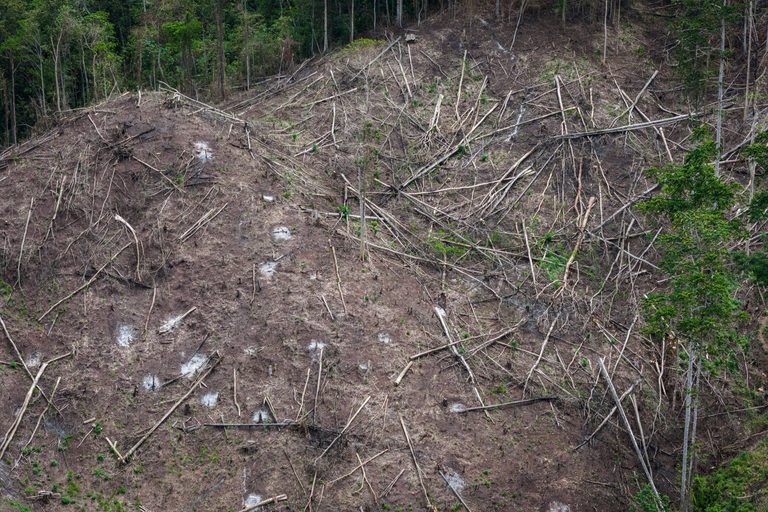
Satellite data released by environmental NGOs reveals a sharp rise in Indonesia’s wood‑pellet and chip production, directly linked to expanding deforestation across the archipelago. The surge is driven largely by Japan’s growing appetite for biomass as it strives to meet its renewable‑energy targets.
Biomass demand and export growth
Timer Manurung, director of the Indonesia‑based group Auriga Nusantara, said the biomass sector has become “a new driver of deforestation in Indonesia.” He noted that most of the wood‑pellet output is destined for export, with Japan the largest market.
Japan imported a record 8.64 million tons of wood pellets in 2025, a 35 percent increase over the previous year, according to the Global Trade Algorithmic Intelligence Center. Imports from Indonesia alone jumped more than 500 percent, rising from 66,460 tons in 2023 to 402,310 tons in 2025.
Environmental concerns
Environmentalists argue that the rapid expansion of biomass concessions—at least 45 permits covering over 750,000 hectares of natural forest—threatens Indigenous communities and critical habitats for species such as tarsiers, endemic buffalo and wild pigs. The Polahi community, which relies on forest resources for its livelihood and cultural identity, faces the loss of its traditional lands.
Critics also point out that burning wood‑based biomass can emit as much carbon as coal, and that converting forest land to bioenergy crops reduces the planet’s natural carbon‑sequestering capacity. The International Energy Agency stresses that sustainable biomass should prioritize waste and crop residues rather than virgin forest.
Japan’s policy response
Japan has curtailed new subsidies for large‑scale biomass projects, but existing certified projects will continue to receive financial support for up to 20 years, according to Katsuhiro Suzushima of the Global Environmental Forum. Loopholes in Japan’s due‑diligence policies may still allow pellets linked to deforestation to enter the market, says forestry specialist Sayoko Iinuma.
The Japanese Forestry Agency declined to comment on the specific link between imported pellets and forest loss, and did not address how its oversight mechanisms will be strengthened.
Balancing energy goals and forest protection
Indonesia’s ministries of Environment and Forestry and Energy and Mineral Resources have not responded to requests for comment. While Japan seeks to diversify away from oil imports, the reliance on wood‑pellet biomass raises questions about whether the policy truly advances clean‑energy objectives or merely prolongs reliance on carbon‑intensive fuels.
Experts stress that a sustainable path forward requires stricter supply‑chain verification, greater use of non‑forest biomass sources, and robust protection for Indigenous lands. Without such measures, the current trajectory risks undermining both countries’ environmental commitments.
Original reporting: Alexandria, VA News – WTOP News — read the source article.