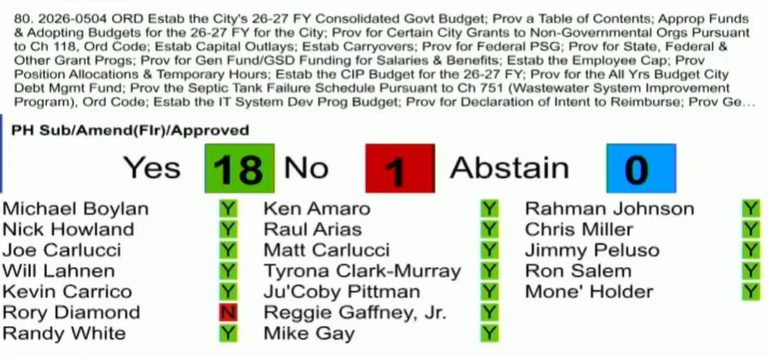
On Tuesday, the Jacksonville City Council voted 18‑1 to adopt a $2 billion municipal budget that balances public safety, infrastructure, and a renewed commitment to affordable housing. Council member Rory Diamond cast the sole “no” vote after a three‑and‑a‑half‑hour debate.
Public‑Safety Funding Holds Steady
The largest portion of the budget – $1.07 billion – is earmarked for the Jacksonville Sheriff’s Office and Jacksonville Fire & Rescue Department. Those figures remained unchanged from Mayor Donna Deegan’s proposal, which kept overall spending flat aside from modest salary increases for police and fire personnel.
Infrastructure and Health Investments
Mayor Deegan’s $586.11 million capital‑improvement plan moves forward, targeting roads, bridges, and water‑system upgrades. The budget also allocates $56 million to UF Health Jacksonville’s indigent‑care program and $2 million to Wolfson Children’s Hospital for pediatric and OB/GYN graduate medical education.
Affordable‑Housing Trust Restored
After the Finance Committee’s August decision to eliminate a new $4.9 million affordable‑housing trust, Council member Matt Carlucci introduced an amendment to reinstate the fund. The amendment passed 12‑7, restoring $2 million for down‑payment assistance, $1.4 million for capital‑stack financing, and $1.5 million for utility‑tap fees for attainable housing.
Mayor Deegan hailed the move as “a win for affordability,” noting that council members listened to residents’ concerns about the housing crisis. Council President Nick Howland, a Republican, defended the council’s overall record, pointing out that since 2023 the city has directed more than $79 million toward affordable‑housing and homelessness‑diversion programs.
Public‑Service Grants Fully Funded
In a bipartisan effort, Council member Jimmy Peluso secured the reinstatement of $2.45 million that had been held back from public‑service grants to local nonprofits. However, the same amount for the Cultural Council of Greater Jacksonville remains tied to the outcome of the upcoming Amendment 3 property‑tax referendum.
Nonprofit leaders, including Darren Dailey of the Jacksonville Children’s Chorus, warned that a delay in cultural‑grant funding could cut their budgets by roughly 20 %, affecting children and families they serve.
Property‑Tax Rate Holds Steady Amid Amendment 3 Uncertainty
With the November 3 property‑tax referendum looming, the council agreed with the mayor to keep the city’s millage rate at 11.1919 mills (about $11.19 per $1,000 of taxable value). The rate also stays unchanged in Duval County’s beach towns and Baldwin.
Council voted 16‑3 on the final tax‑rate approval, with Diamond, Kevin Carrico, and Mike Gay opposing. Should Amendment 3 pass, the council and the Deegan administration said they may need to revisit the budget to address a projected $300 million revenue shortfall by 2028.
Community Voices Highlight Need for Housing Support
Joy Viau of the Interfaith Coalition for Action, Reconciliation and Empowerment, representing 38 faith congregations, testified that affordable‑housing programs protect vulnerable seniors as well as young families. She shared a personal story about her 98‑year‑old mother, a retired teacher who still relies on family support to stay in her home.
Overall, the budget reflects a balanced approach: robust funding for first‑responders, strategic infrastructure investment, and a restored safety net for families seeking homeownership.
Original reporting: Jacksonville Today — read the source article.